
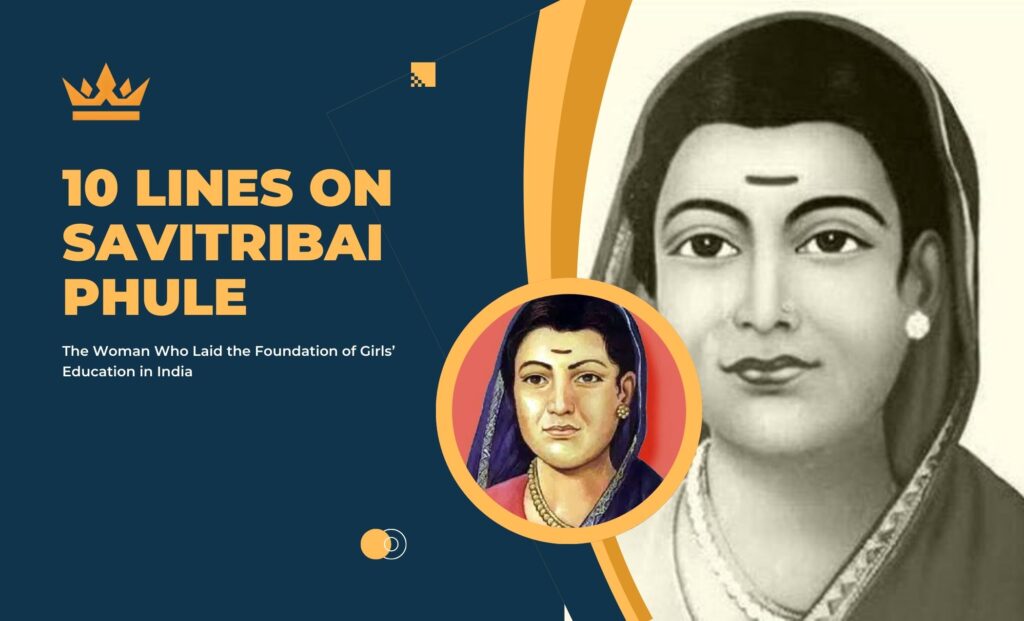
Savitribai Phule’s life is simple to tell but powerful to feel. She lived in a time when most women had no school and few rights. She taught girls to read and write. She spoke for those who had no voice. Her work touched education, caste equality, women’s dignity, and public health.
This article gives a human, easy-to-read account of her life. It is built around ten main themes. Each theme is short, clear, and factual. The language is plain so more readers can understand and remember her work.
10 Lines on Savitribai Phule
- Savitribai Phule was born on 3 January 1831 in Naigaon, Maharashtra.
- She became one of India’s first trained woman teachers.
- In 1848 she opened the first school for girls in Pune with her husband, Jyotirao Phule.
- Her schools taught girls from all castes and social backgrounds.
- She faced insults, stones, and public abuse but continued to teach.
- She worked for women’s rights, widow rescue, and against child marriage.
- She wrote poems and short essays to spread the message of equality.
- She served the poor and sick during the 1897 plague and died helping others.
- Her life inspired later social reformers and public memory in India.
- Today she stands as a symbol of education, equality, and social service.
1. Early life and first lessons
Savitribai was born on 3 January 1831 in a village called Naigaon. She belonged to a family that worked on the land. In her childhood, girls rarely learned to read. They married early and worked inside the home. Savitribai married Jyotirao Phule when she was young. Jyotirao believed in learning and equality. He taught Savitribai the basics of reading and writing. That early support changed her life. It showed how one person’s encouragement can open a new path.
2. Training to teach and building confidence
After learning at home, Savitribai went to Pune for teacher training. At that time, trained teachers were rare and trained women teachers were even rarer. She learned lesson planning, classroom discipline, and how to teach children to read. Training helped her speak publicly and face critics calmly. In 1848 she began her teaching career in a formal way. Her training gave her tools and confidence. Those tools would be used not only for lessons but also for building schools and training other women.
3. Opening schools: the first step to change
In 1848 Savitribai and Jyotirao opened a small school at Bhide Wada in Pune. Their first classrooms were simple and often crowded. They taught basic reading, writing, and counting. They also taught practical knowledge for daily life. The Phules welcomed girls from different castes and backgrounds.
This move challenged the social norms of the time. Many families feared sending girls to school. The Phules believed education could give women dignity and help families. Opening that first school was a bold step. It proved that change could begin in a small room with a few eager children.
4. Daily courage: facing ridicule and violence
Teaching girls brought violent reactions from some people. Savitribai faced insults and public humiliation. On her way to school, people sometimes spat at her or threw stones. They wanted to scare her away. To keep going, she developed practical habits. She would carry an extra sari to change if someone dirtied her clothes. She kept teaching despite constant danger. Her courage was quiet and steady. It came from belief rather than from anger. She kept her focus on children and learning.
5. Work beyond schools: women’s dignity and rescue
Savitribai did more than teach. She worked for widows, child brides, and other women in trouble. She organized shelters for widows who had no place to stay. She spoke against forced child marriage. She helped women who were punished by social customs.
Education was her main tool, but she paired schooling with care. She believed a classroom could change a life only if the girl had food, shelter, and safety. Her rescue work showed that education must be part of a larger care system.
6. Fighting caste discrimination: schools for everyone
The Phules fought the caste system too. They opened their doors to children from lower castes. This was radical in a society where public places were divided by caste. The Phules believed that birth should not decide a person’s fate.
By teaching children of different backgrounds in the same room, they created small, daily acts of equality. These small acts taught respect and common sense. They showed children how different life could be when people learned together.
7. Writing and poetry: simple words, strong message
Savitribai wrote poems and short pieces with clear and strong messages. Her poems spoke about dignity, education, and hope. They were written in a simple style so ordinary people could read them. Writing let her spread ideas beyond her classroom. Poems reached hearts in villages and towns. Her words encouraged women to seek learning. She used writing as a gentle tool to change how people thought about gender and caste.
8. Public health and care: serving in crisis
For Savitribai, teaching and caring were linked. She taught basic hygiene and helped around childbirth. When sickness spread, she helped at clinics and comforted the sick. In 1897 Pune faced a plague outbreak. Medical knowledge and protection were limited then.
Savitribai worked in the clinics and cared for infected people. While tending to a sick child she caught the infection herself. She died on 10 March 1897. Her death is remembered as an act of service. She chose to help others even when danger was real.
9. Partnership with Jyotirao: shared work, shared risks
Savitribai’s work cannot be told without mentioning her husband Jyotirao Phule. They were partners in life and in mission. Jyotirao wrote and spoke against caste and social inequality. Savitribai turned many of those ideas into concrete projects.
They opened schools together and trained teachers. The partnership gave strength and shared risk. When their schools were attacked, both faced danger. They worked as a team. That teamwork helped them reach more people and sustain their efforts.
10. Legacy: memory, institutions, and living lessons
Savitribai’s life did not end with her death. Schools and public programs now bear her name. Statues, college names, and awards remind people of her work. Her story teaches that education is a tool for dignity. It also teaches that care and practical help must go with critique and reform. Her legacy lives in classrooms and in social movements. People still cite her as an example of steady, practical action for justice.
A human picture: a day in Savitribai’s classroom
Imagine a hot morning in Pune in the mid-1800s. A small room with wooden shutters holds a group of children. Some sit on mats, others on the floor. Savitribai enters with a calm voice. She starts with a rhyme to make the children smile.
She holds up a letter card and asks the pupils to repeat. If a child cries, she comforts them and makes space. The lessons mix letters with simple stories of daily life. When she teaches numbers, she uses grains of rice or pebbles to show counting. This practical, patient method helped many children learn quickly and with confidence.
Teaching method and training teachers
Savitribai used simple tools and taught with common sense. She trained local women to teach, so the work could spread. She relied on stories, songs, and household examples. Lessons were short and repeated often for learning to stick. This method was humble but effective. Training other women was key. It made education a community task rather than the job of a single person. Her idea to train local teachers helped schools grow beyond one place.
How she persuaded families to send girls to school
To convince families, Savitribai used small, practical arguments. She showed that a literate mother can read medicine labels or keep simple records for the household. She said education could help in daily chores and in managing money.
She spoke gently to mothers and fathers, not in harsh arguments. Over time, parents who feared change saw real benefits. They began to send their daughters to school. This slow, careful persuasion was a major reason why the Phules’ work spread.
Limits and honest appraisal
No reformer can reach everyone immediately. Savitribai’s schools could not open in every village. Some families resisted for decades. Resources were thin. The Phules worked within the limits of their time and means. Recognizing these limits is not to weaken her legacy. It helps us learn how to build stronger systems today—systems that combine education, health, and social support to reach the poorest people.
Lessons for today’s educators and activists
Savitribai’s life teaches simple, practical lessons for modern work:
- Start small and steady.
- Combine education with care and basic services.
- Train local people to lead teaching.
- Use simple, practical examples to persuade families.
- Measure success by small human changes, not only by large claims.
These ideas are low-cost and rooted in trust. They can help small projects grow into lasting programs.
Recognition and public memory
Over the decades, many schools, colleges, and public programs have been named after Savitribai Phule. Her birthday is marked by celebrations and school events. Teachers and activists point to her life when they talk about women’s education. These honors keep her memory alive and invite new generations to learn from her example.
Timeline of key dates (quick view)
- 3 January 1831: Birth in Naigaon.
- c. 1840s: Early lessons from Jyotirao Phule and move toward teacher training.
- 1848: First school for girls opens in Pune (Bhide Wada).
- 1850s–1880s: Expansion of teaching work, writing, and social projects.
- 1897: Plague outbreak; Savitribai cares for the sick and dies on 10 March 1897.
Final reflections: quiet courage that speaks loudly
Savitribai Phule did not live in a newspaper age where every deed appears in print. She lived in small rooms and in everyday acts of teaching. Her courage was quiet. Her method was practical. Her heart cared for the poor and the sick. If we look for big bold gestures, we may miss her true power. Her real strength was to remain steady, to teach day after day, and to combine learning with care. That steady life changed people and helped change a culture.
Practical ideas to honor her work today
If you want to act in her spirit:
- Teach a child or read aloud in your neighborhood.
- Help a local teacher with supplies or time.
- Support community classes that combine health and learning.
- Share stories of Savitribai with students to inspire them.
- Volunteer at local shelters or education programs.
These small acts keep her legacy active and useful.
Conclusion
Savitribai Phule’s life is a clear lesson in humility, courage, and steady action. She used education as a practical tool to bring dignity to girls and to challenge unjust practices. She paired teaching with rescue work and care for the sick. Her partnership with Jyotirao helped turn ideas into lasting action.
Though she died while serving the sick in 1897, her influence lives on in classrooms, public memory, and in the small acts of care that everyday people carry out. Her life invites us to do one humble thing well. That is how social change often begins.