
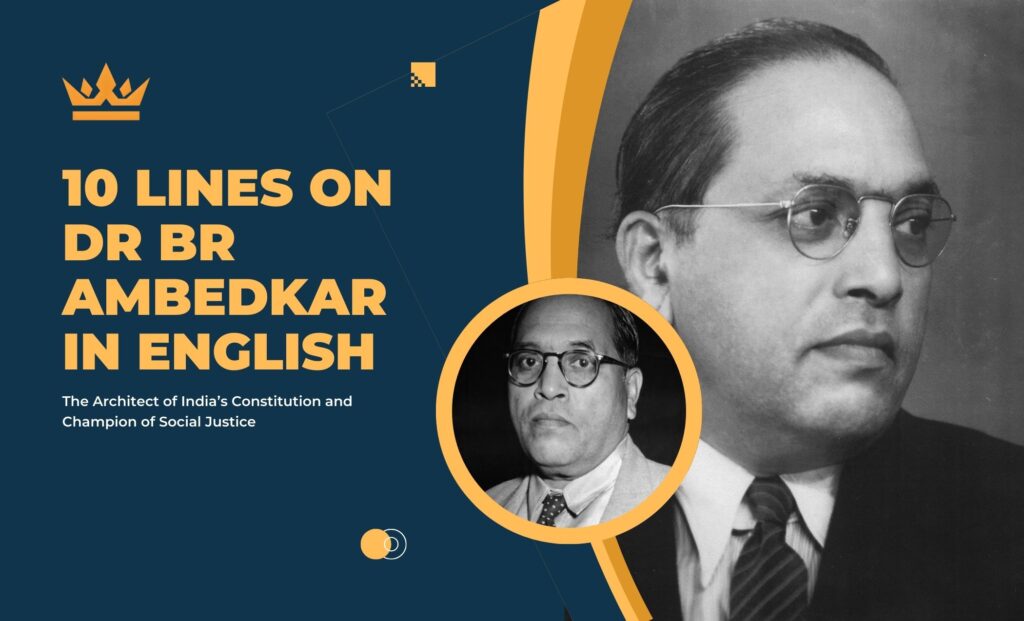
Dr Bhimrao Ramji Ambedkar is a leader many people admire. People often search for 10 Lines on Dr BR Ambedkar in English to learn the main facts quickly. He was born on April 14, 1891, in Mhow. As a child he faced harsh caste discrimination, yet he kept studying and won scholarships to study abroad at Columbia University and the London School of Economics.
He became a lawyer, a scholar, and the chief architect of the Indian Constitution. He served as India’s first law minister and worked hard to make laws that protect everyone. He led movements against untouchability and argued that education and organisation are the best tools for change.
In 1956 he embraced Buddhism as a way to reject social hierarchy and to claim equal dignity for all. Today his ideas shape India’s laws, public policy, and many social movements. Learning about his
10 Lines on Dr BR Ambedkar in English
- Dr B. R. Ambedkar was a great leader, thinker, and social reformer of India.
- He was born on April 14, 1891, in Mhow, in present day Madhya Pradesh.
- He faced discrimination from a young age but never gave up on education.
- He believed that education is the strongest tool to change society.
- Dr Ambedkar was the chief architect of the Indian Constitution.
- He worked for equality, justice, and the rights of oppressed people.
- He strongly opposed caste discrimination and social injustice.
- Dr Ambedkar served as India’s first law minister.
- His life teaches us courage, hard work, and self respect.
- Dr B. R. Ambedkar continues to inspire India to stand for equality and dignity.
These ten lines give a short picture of a long and meaningful life. The sections below explain his journey in more detail.
Early Life and Childhood
Dr Bhimrao Ramji Ambedkar was born on April 14, 1891, in the town of Mhow. He grew up in a time when caste discrimination was harsh and widely accepted. His family belonged to a group that faced social exclusion. Even though his father served in the British Indian Army, the family did not receive social respect.
As a child Ambedkar faced many small humiliations that were part of daily life. In school he was asked to sit apart from other children. He was not allowed to drink from the same water pot as others. Often he had to wait for water or food that others took for granted. These were not rare incidents. They were repeated many times and they left a deep mark.
These early experiences caused deep pain. At the same time they shaped his thinking. Ambedkar learned that the problem was not his own weakness. The problem was an unfair social system that stopped people from living with dignity. That idea guided his whole life. He did not accept the punishment of being treated as less than human. He made education and law the tools to fight that unfairness.
Education as the Road to Freedom
Education was central to Ambedkar’s life and to his plan for change. His family believed that learning could open doors that society tried to close. Ambedkar studied hard from a young age and showed strong ability in his studies.
He attended Elphinstone College in Bombay, where hard work brought him respect for his academic abilities. Later he won a scholarship to study in the United States. He went to Columbia University in New York. For a young man from a marginalized background, this was a rare opportunity.
At Columbia he studied economics and political science. He read about democracy, rights, and social justice. These ideas sharpened his thinking and gave him new tools to argue for change. After Columbia he went to the London School of Economics. He also trained as a lawyer in England and became familiar with law in Britain.
Ambedkar did not see education as merely personal success. He believed that education gives people power. Knowledge lets people question unfair rules. It helps them claim rights and demand a fair place in society. For him, the classroom was a place to prepare people for the larger fight for dignity.
Return to India and Social Awakening
When Ambedkar returned to India he found that social life had not changed enough. Political leaders were discussing freedom and self rule. At the same time many social problems remained hidden or ignored. For Ambedkar political freedom without social equality felt incomplete.
He began to write and speak about the need to end untouchability and caste oppression. He started journals to explain his ideas. He spoke to large crowds. He met people who were suffering and he gave them a language to describe that suffering. He asked them not to accept humiliation as their fate.
He taught that dignity must be demanded. He urged people to get education, to organize together, and to use the law if possible. He trained leaders who could speak for their communities. He built networks of students, activists, and writers who could carry the message forward.
Social Reformer in Action
Ambedkar’s work was practical and focused. He led campaigns for access to public water, to schools, and to places of worship. He argued that if a society claims to be modern and just, then public places must be open to all citizens.
He wrote articles that explained the harm caused by caste rules. He used evidence, history, and legal arguments to show why caste discrimination kept people poor and powerless. He did not accept religious or traditional excuses for cruelty.
Ambedkar believed in the dignity of the person. He insisted that law must protect dignity. Where social customs denied human worth, the state and its laws should step in. He offered a clear program: educate the people, agitate peacefully for rights, and organize collective action to win small but important gains.
Core Ideas and Beliefs
Ambedkar’s ideas were grounded in clear values. He believed in equality. For him equality was not only a moral idea. It was a practical requirement for a functioning society. A country cannot claim to be free while it allows a majority of citizens to live without equal rights.
He believed in education. He saw schooling and study as a way to understand rights and to build confidence. Education was the path to the skills and knowledge needed to claim a place in modern life.
He believed in justice through law. He thought that strong laws and clear legal rights protect vulnerable people. Without legal protections, customs and social pressure would continue to harm people.
He believed in freedom of thought. He encouraged people to reason and to question old rules. He believed that social progress requires constant questioning of inherited ideas.
He believed in fraternity. He felt that a divided society could not survive. People need to feel a bond of common citizenship to build a stable nation.
These ideas later became the foundation of the Indian Constitution and the core messages of his public life.
Role in Drafting the Indian Constitution
Ambedkar’s role in framing the Indian Constitution is a major part of his public legacy. He served as the chairman of the Drafting Committee. He brought legal skill, a sense of fairness, and careful thinking to the task. He read constitutions from many countries and chose ideas that could fit India’s large and diverse population.
He wanted a Constitution that would protect individual rights and guard against discrimination. The Constitution gives citizens equality before the law. It protects freedom of speech and freedom of religion. It seeks to guarantee that no citizen is denied rights because of caste, creed, gender, or place of birth.
Ambedkar also pushed for provisions that recognize historical disadvantage. He believed that equality sometimes requires special steps to create equal opportunity. He supported measures to help those who had been excluded for generations.
Through his work on the Constitution he shaped institutions that could be used by ordinary citizens to seek justice. He argued that law is not a tool for the powerful alone. Law can be a ladder for the excluded.
Public Service as Law Minister
After independence Ambedkar served as India’s first law minister. In that role he tried to make laws work for all citizens. He proposed reforms to modernize legal rules and to improve women’s rights. He wanted the legal system to be more accessible and more fair.
His proposals faced strong resistance. Many social customs were deeply rooted and people feared change. Religious leaders and conservative groups sometimes opposed his ideas. Despite resistance he continued to argue for change. He believed that laws must evolve as society changes.
As law minister he worked to write clear rules that protected individual rights. He believed that institutions matter. He wanted courts, schools, and government offices to be places where ordinary citizens could expect fairness.
Challenges and Opposition
Ambedkar’s path was not easy. He faced fierce opposition from many directions. Conservative elements resisted his critique of caste. Some political leaders disagreed with his methods. He sometimes felt isolated and frustrated.
Even his allies sometimes found it hard to fully accept his ideas. Reform requires both courage and patience. Ambedkar often had to face delays and setbacks. Yet he did not give up core principles.
He remained clear about his aims. He argued through reasoned debate and public writing. He kept organizing and teaching. His steadiness in the face of opposition made his work more credible. It also showed the depth of his moral commitment.
Influence on Modern India
Ambedkar’s influence is visible in many parts of modern India. Debates about constitutional law, social justice, and public policy often reflect themes he raised. His work shaped public institutions and legal protections that ordinary citizens can use.
Education programs, public policy on equal access, and laws against discrimination draw from his ideas. Courts use the Constitution he helped draft to decide many important cases. Activists and social workers also use his language to demand change.
His emphasis on legal remedies and public institutions shows how law and social action can work together. His influence continues through scholarship, law schools, and public debate.
Major Writings and Public Ideas
Ambedkar wrote books, essays, and speeches that remain important. His writings explained in clear terms how caste inequality works. He wrote about the economics of poverty and about ways the state can help.
His words were practical and aimed at action. He did not simply describe injustice. He proposed solutions. He asked people to educate themselves, to speak out, and to organize peacefully for their rights.
His phrase “educate, agitate, and organize” continues to inspire movements. The phrase gives a simple plan for social change and it connects study with public action.
Major Actions and Local Campaigns
Ambedkar’s work included many local campaigns that changed daily life. He led efforts to open public water sources to everyone. He fought for the right of people to enter schools and public buildings. These actions showed that small, focused efforts can change everyday reality.
He also worked to build institutions. He helped set up schools and encouraged community organizations. His local campaigns often became models for wider action.
Conversion to Buddhism and Final Years
In the last year of his life Ambedkar embraced Buddhism. For him, this was more than a personal spiritual choice. Buddhism offered a path that rejected social hierarchy and treated every person as equal. By choosing Buddhism publicly, Ambedkar gave many followers a new way to claim dignity and to reject caste abuse.
He passed away in 1956. His death was a moment of deep loss for many. Yet his ideas continued to live in institutions, in public debate, and in the actions of people who had learned from him.
Institutions, Names, and Public Life
Ambedkar’s name is found in many public places. Universities, research centers, and law colleges bear his name. Public squares and memorials remember his life. Awards and scholarships honor students who follow his ideals.
These institutions help keep his memory alive. They also remind new generations of the values he championed. Schools teach his life and writings. Law students read his speeches. Activists continue to draw on his arguments.
Reservation and Policy Influence
Ambedkar argued that equal opportunity sometimes requires special measures. Reservation policies, scholarships, and special programs are steps designed to correct long years of exclusion. He saw these measures as temporary tools to reach real equality.
These policies continue to be debated. People discuss how best to implement them and how to make sure they work fairly. The debates show that democracy is alive. Ambedkar gave the tools to argue both for and against policy choices with a common language of rights and fairness.
Ambedkar and Women’s Rights
Ambedkar also supported stronger legal rights for women. He believed legal reform could improve women’s status in marriage, property, and public life. He argued that women should have clear rights under law and access to education and work.
His support helped start debates and eventual reforms. Over time laws changed in ways that improved women’s legal standing. Social change is slow, yet the legal ideas Ambedkar promoted created space for progress.
Stories and Small Acts
There are many small stories people tell about Ambedkar to keep his memory alive. A teacher reads his life to students in a classroom. A young activist repeats his phrase “educate, agitate, and organize” at a community meeting. A local group opens a water tank that was once closed to many people.
These everyday stories show how big ideas become real through small acts. They help people see history as something that touches daily life. They make Ambedkar’s life real and personal for each new generation.
Practical Lessons and Current Debates
Ambedkar’s life gives practical lessons for today. When people argue about fairness they often use the language of rights that Ambedkar helped shape. When governments plan education and social programs they often rely on principles he urged.
At the same time, his ideas are part of active debate. People discuss how to run affirmative measures, how to balance rights, and how to change social attitudes. These debates are a healthy part of living democracy. Ambedkar’s work gives tools to think clearly about these issues.
A Human Story of Courage
Above all Ambedkar’s life is a human story. He was a person who faced deep unfairness and chose to study and to act. He built institutions, wrote books, and used the law to protect people. His life shows that steady effort by one person can change many lives.
He did not seek personal glory. He sought a fairer society. He worked by reason, by law, and by public action. His courage came with careful thinking. He believed in institutions and in the capacity of ordinary people to claim rights.
Public Memory and Celebration
Ambedkar is remembered across India and beyond. Ambedkar Jayanti is celebrated every April 14 with talks, community events, and public ceremonies. His books are studied in law and social science classes. His speeches are quoted in public debates and used as lessons in classrooms.
Statues and memorials stand in public places to remind citizens of his life. These public signs help keep his message alive and show that a society can choose to honor those who fought for justice.
Final Thoughts
Dr B. R. Ambedkar’s life and ideas continue to inspire generations to build a fairer and more just society. He showed that dignity comes not only from legal rights but also from social change and personal courage. He believed that education gives people the tools to understand, claim, and defend their rights.
His vision calls on every person to work for a society where opportunity, respect, and justice are available to all, regardless of caste, gender, or background. He taught that equal rights require steady effort, careful laws, and public education.
Ambedkar left practical tools for change. He left a Constitution that protects rights. He left writing that explains injustice. He left a life that shows how steady work and clear thinking can change a nation.
If students, teachers, and citizens remember his lessons, they can use them to face the challenges of today. Ambedkar’s life is a call to act with dignity and with reason. It is a reminder that social change requires courage, planning, and the will to keep going even when the path is hard.
