
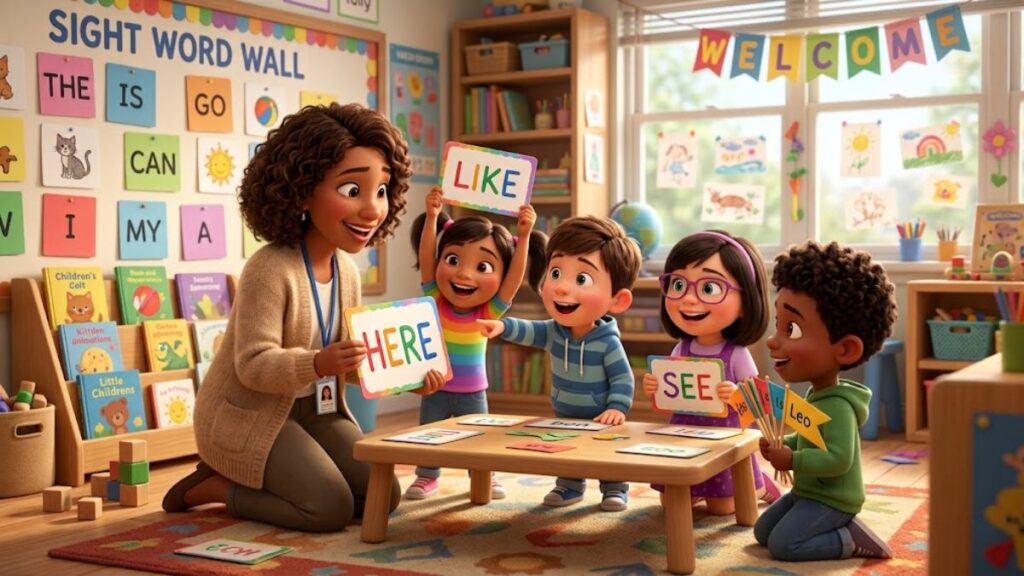
Teaching sight words to kindergarteners is an important part of early reading instruction. Young children encounter many high-frequency words repeatedly in books, classroom materials, and everyday writing. When they become familiar with these words, they can read simple sentences more smoothly and spend more attention on understanding what they are reading.
However, teaching sight words should not mean asking children to memorize long lists of words. Kindergarteners learn best through short lessons, repetition, phonics, games, books, writing activities, and hands-on practice.
This detailed guide explains how to teach sight words to kindergarteners, including how to choose words, introduce them step by step, use games and activities, combine sight words with phonics, create a daily routine, handle struggling learners, and make practice enjoyable.
What Are Sight Words?
Sight words are words that children are encouraged to recognize quickly when they see them in print.
Many are common words that appear frequently in children’s books and simple sentences.
Examples include:
- I
- a
- the
- is
- it
- in
- on
- to
- we
- can
- see
- my
- me
- go
- and
- you
- he
- she
- are
- was
The exact list can vary between schools, reading programs, and educational approaches.
It is also important to understand that sight words and high-frequency words are not always exactly the same thing. A high-frequency word is simply a word that appears often. Some can be sounded out using phonics, while others contain spelling patterns that young readers may not yet know.
Why Are Sight Words Important for Kindergarteners?
Children encounter common words repeatedly when they begin reading.
Consider the sentence:
I can see the dog.
If a child quickly recognizes I, can, see, and the, they can focus more easily on the meaning of the sentence.
Sight-word knowledge can support:
- Reading fluency
- Word recognition
- Sentence reading
- Reading confidence
- Comprehension
- Independent reading
- Writing development
The goal is not simply to increase the number of memorized words. The larger goal is to help children become increasingly accurate, automatic, and confident readers.
When Should You Start Teaching Sight Words?
There is no universal starting date that applies to every child.
Kindergarten is often an appropriate time to begin systematic work with common high-frequency words while children are also developing:
- Phonemic awareness
- Letter knowledge
- Letter-sound relationships
- Phonics skills
- Vocabulary
- Oral language
- Listening comprehension
Sight-word learning should develop alongside these foundational skills.
A child who is still learning basic letter sounds may need more support than a child who already reads simple words.
How Many Sight Words Should Kindergarteners Learn?
There is no single number that every kindergartener must learn.
Different schools and curricula may have different expectations. Rather than focusing only on reaching a particular number, focus on whether the child can recognize, read, and use the words they have been taught.
Start with a small group.
For example:
I, a, the, is, in
After children become comfortable with these, introduce additional words.
This gradual approach prevents children from becoming overwhelmed.
How to Choose Sight Words
When choosing words, consider:
- Frequency: Choose words children are likely to encounter often.
- Usefulness: Words that can easily be used in simple sentences are especially helpful.
- Phonics Knowledge: Consider which spelling patterns the child already understands.
- Reading Level: Choose words that appear in the books and sentences the child is reading.
- Difficulty: Do not introduce a large number of unusually difficult words at once.
The goal is to create a manageable learning progression.
How to Teach Sight Words to Kindergarteners
Teaching sight words to kindergarteners can be simple and engaging with the right approach. Explore fun, age-appropriate activities that help young learners recognize, read, spell, and use common sight words with confidence.
Introduce Only a Few Words at a Time
One of the most effective ways to teach sight words is to avoid overwhelming children.
Instead of presenting 15 or 20 new words at once, introduce a small number.
For example:
- Group 1: I, a, the
- Group 2: is, it, in
- Group 3: my, we, can
- Group 4: see, go, to
The exact grouping is flexible.
The important principle is small amounts of new information combined with plenty of review.
Say the Word Aloud
When introducing a new sight word, show it clearly.
For example:
the
Say:
“This word is the.”
Have the child repeat it.
Then use it in a sentence:
The dog is big.
This gives the child three connections:
Printed word → spoken word → meaning
These connections are more useful than simply staring at a flashcard.
Explain the Meaning
Young children learn words more effectively when they understand what those words mean and how they are used.
For example:
my
You might say:
“My means something belongs to me.”
Then give an example:
“This is my book.”
For simple grammatical words such as the, you do not necessarily need a long definition. Instead, demonstrate how the word works in sentences.
Connect Sight Words With Phonics
Sight-word instruction should not replace phonics.
Children should continue learning how letters and spelling patterns represent sounds.
For example:
can
A child can use phonics knowledge to identify:
c → /k/
a → /ă/
n → /n/
Then blend the sounds:
c-a-n → can
This helps children understand the relationship between sounds and letters.
For words with an irregular spelling pattern, you can explain which parts are regular and which part needs special attention.
This is more informative than simply saying:
“Memorize this word.”
Use a Look, Say, Read, Write Routine
A simple routine can provide repeated exposure.
- Look: Show the word.
- Say: Say the word together.
- Read: Ask the child to recognize it.
- Write: Have the child write or build the word.
For example:
the
The child:
- Looks at the
- Says “the”
- Reads it independently
- Writes the
This takes only a short amount of time but provides several forms of practice.
Use Sight Words in Sentences
Individual word recognition is useful, but children also need to see words in context.
Instead of practicing:
- I
- can
- see
only as separate cards, combine them: I can see.
Then add another word: I can see a dog.
This shows children why sight words matter.
Read Sight Words in Children’s Books
Books provide natural opportunities for repetition.
Before reading, introduce one or two target words.
For example: “Today we’re looking for the word can.”
During reading, ask: “Can you find can?”
This turns reading into an interactive activity.
Children begin to understand that the words they practice are the same words they encounter in real books.
Read Familiar Books Repeatedly
Repeated reading can be especially useful for kindergarteners.
During the first reading, focus primarily on understanding the story.
During another reading, ask children to notice familiar words.
For example:
“How many times can you find the?”
Repeated reading helps children become more comfortable with both vocabulary and common word patterns.
Play Sight Word Bingo
Create a simple bingo card containing words the child already knows.
Call out a word.
For example:
“my”
The child looks for my and marks it.
Continue until they complete a row or another agreed pattern.
Bingo provides repetition without making the activity feel like a formal test.
Create a Sight Word Hunt
Write target words on cards and place them around a room.
Say:
“Find the word is.”
The child searches for the correct card.
Once they find it, ask them to read it aloud.
You can make the activity more challenging by adding several familiar words.
Use Movement-Based Activities
Kindergarteners often enjoy activities that allow them to move.
Write sight words on pieces of paper and place them on the floor.
Then give instructions such as:
- “Jump to the.”
- “Stand on can.”
- “Touch my.”
- “Find is.”
Movement can make repeated recognition practice more engaging.
Build Sight Words With Letter Tiles
Magnetic letters, plastic tiles, or paper letters can help children understand how words are constructed.
For example:
c + a + n = can
Ask:
“What word did we make?”
Then have the child read it.
This activity works particularly well when combined with phonics.
Write Sight Words in Sand or Salt
Pour a small amount of sand or salt into a shallow tray.
Say a word such as:
is
Ask the child to write it with a finger.
Then have them read the word.
This adds a tactile component to learning and can be especially engaging for children who enjoy hands-on activities.
Use Magnetic Letters
Place magnetic letters on a refrigerator, whiteboard, or magnetic surface.
Ask the child to build: I
Then: it
Then: in
You can also mix up the letters and ask the child to rebuild the word correctly.
Make Sight Word Matching Cards
Create pairs of cards with the same words.
For example:
the | the
can | can
my | my
Place them face down.
The child turns over two cards at a time and tries to find matching pairs.
When a match is found, the child reads the word.
Create a Sight Word Memory Game
A memory game can combine recognition with concentration.
Place pairs of sight-word cards face down.
The child turns over two cards.
If they match, they keep the pair.
If they do not match, they turn them back over.
Before keeping a pair, the child should read the word aloud.
Use Sight Word Puzzles
Cut words into simple pieces or create word puzzles.
For example: c + an
or individual letters: c + a + n
The child puts the pieces together and reads the completed word.
This is particularly useful for children who benefit from manipulating physical objects.
Practice Through Writing
Writing reinforces reading.
Ask children to write newly learned sight words.
Start with:
- Tracing
- Copying
- Completing missing letters
- Writing independently
For example: t _ e
The child completes: the
Gradually reduce the amount of support.
Let Children Create Simple Sentences
Once children know several words, encourage them to create short sentences.
For example:
- I can run.
- I see a dog.
- My cat is big.
The sentence does not need to be grammatically complex.
The goal is to help children see that words work together to communicate meaning.
Combine Drawing and Writing
Ask the child to draw something and write a sentence about it.
For example:
A child draws a dog.
Then writes: I see a dog.
This connects: Thinking → speaking → writing → reading
and makes literacy practice more meaningful.
Use Songs, Rhymes, and Chants
Repetition can become much more enjoyable when paired with rhythm.
For example:
“Can, can, can,
I can read can!”
You can create simple chants around the words being practiced.
The exact wording is less important than making the activity memorable and repetitive.
Use Technology Carefully
Digital games and educational apps can provide additional practice, but they should not replace interaction with books, writing, conversation, and hands-on activities.
If using digital activities, choose ones that encourage children to:
- Recognize words
- Listen to words
- Match words
- Build words
- Read words in sentences
Keep screen-based practice brief and purposeful.
A Simple Daily Sight Word Routine
A 10–15 minute routine might look like this:
- 2 Minutes – Review: Review three to five familiar words.
- 3 Minutes – New Word: Introduce one new word.
- 3 Minutes – Word Activity: Use cards, tiles, writing, or a game.
- 3 Minutes – Sentence Reading: Read two or three simple sentences.
- 2–4 Minutes – Book Practice: Look for the target word in a beginner-level book.
This routine can be adjusted based on the child’s attention span.
A Weekly Sight Word Plan
A simple weekly structure could look like this:
| Day | Activity |
|---|---|
| Monday | Introduce 1–2 new words |
| Tuesday | Read, write, and build the words |
| Wednesday | Play a sight-word game |
| Thursday | Find the words in books and sentences |
| Friday | Review all words through a fun activity |
The exact schedule does not matter as much as consistent review and meaningful practice.
How to Teach Sight Words to Different Types of Learners
Children do not all learn in the same way.
Visual Learners
Use:
- Word cards
- Word walls
- Colorful writing
- Large print
- Matching activities
Auditory Learners
Use:
- Repetition
- Songs
- Chants
- Reading aloud
- Word discussions
Hands-On Learners
Use:
- Magnetic letters
- Sand writing
- Letter tiles
- Word puzzles
- Movement games
Using several approaches gives children more opportunities to connect with the words.
How to Review Previously Learned Words
Review is essential.
A child may recognize a word today and forget it tomorrow. This is normal during early literacy development.
Create three groups:
- New Words: Words being introduced.
- Learning Words: Words that need regular practice.
- Known Words: Words the child recognizes consistently.
Spend most of the practice time on new and learning words while occasionally reviewing known words.
How to Help a Kindergartener Who Struggles
If a child has difficulty remembering sight words, reduce the workload.
Instead of practicing ten words, practice three.
Use:
- Repeated reading
- Word cards
- Writing
- Letter tiles
- Games
- Simple sentences
- Picture-supported activities
Most importantly, avoid turning mistakes into a source of embarrassment.
If the child says:
“Can” for can, praise the successful recognition.
If they cannot identify the, calmly say:
“This word is the. Say it with me.”
Then revisit it later.
How to Keep Children Motivated
Young children respond well to encouragement.
Instead of focusing only on mistakes, recognize progress.
You can say:
- “You remembered that word!”
- “You found the all by yourself.”
- “You read that sentence!”
- “You remembered it from yesterday.”
You can also use simple progress charts or stickers, but avoid making rewards the only reason to read.
The ultimate goal is to help children discover that reading itself can be enjoyable.
Sight Words Should Not Replace Phonics
This is an important part of early reading instruction.
Children need systematic opportunities to learn:
- Letter sounds
- Blending
- Segmenting
- Phonemic awareness
- Spelling patterns
- Decoding
Sight-word practice should complement these skills.
For example, if a child sees:
cat
they should ideally be able to use phonics knowledge to decode it rather than memorize every occurrence of the word.
This helps children develop skills that can transfer to unfamiliar words.
How Parents Can Practice Sight Words at Home
Parents do not need to create complicated lessons.
A few minutes during everyday activities can be useful.
- During Story Time: Ask -“Can you find the?”
- During Writing: Ask the child to use I in a sentence.
- Around the House: Put familiar words on cards.
- During Play: Use sight words in pretend menus, signs, shopping lists, or notes.
- During Car Rides: Look for familiar words on appropriate signs or printed materials.
The aim is to make reading part of everyday life.
How Teachers Can Integrate Sight Words Into the Classroom
Teachers can reinforce words throughout the school day.
Use them during:
- Morning messages
- Calendar activities
- Shared reading
- Writing centers
- Small-group reading
- Classroom labels
- Word walls
- Literacy games
- Story time
Repeated exposure across different activities can make recognition more natural.
Common Mistakes to Avoid
- Teaching Too Many Words: A large list can overwhelm young learners.
- Using Only Flashcards: Flashcards are useful, but children also need books, sentences, writing, and games.
- Ignoring Phonics: Children need decoding skills in addition to rapid recognition of familiar words.
- Making Lessons Too Long: Short, focused sessions are generally better suited to kindergarteners.
- Treating Mistakes as Failure: Mistakes are part of learning.
- Never Reviewing Old Words: Previously learned words need continued exposure.
- Teaching Words Without Meaning: Whenever possible, connect words to sentences, stories, and real communication.
Signs That a Child Is Making Progress
Progress does not simply mean memorizing more words.
Look for signs such as:
- Recognizing familiar words more quickly
- Needing fewer prompts
- Reading simple sentences more smoothly
- Finding words in books independently
- Using sight words in writing
- Becoming more willing to read
- Correcting some mistakes independently
These behaviors show that word recognition is becoming more automatic.
Final Thoughts
Learning sight words is an important part of kindergarten literacy, but it works best when children are taught how words work, not simply asked to memorize long lists.
A balanced approach combines sight-word recognition with phonics, phonemic awareness, reading, writing, oral language, and meaningful practice. Introduce only a few new words at a time, review them regularly, and use them in sentences and children’s books.
Most importantly, keep the experience positive. Kindergarteners are developing foundational reading skills at different rates, so patience and consistency matter more than rushing through a particular word list.
With short daily practice, engaging activities, repeated exposure, and plenty of encouragement, children can gradually become more confident recognizing common words and using them as they begin their journey toward independent reading.
