
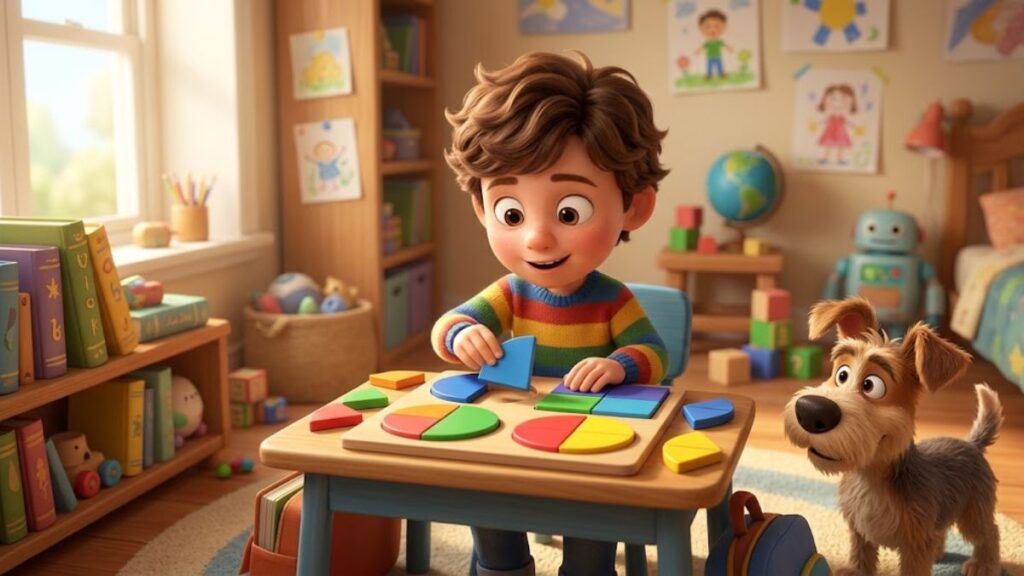
Fractions are an important part of mathematics, but children do not need to begin with complicated calculations. The foundation for fraction understanding can develop surprisingly early through simple activities such as sharing food, folding paper, dividing toys, and comparing parts of a whole.
For many children, informal fraction concepts can be introduced during preschool and kindergarten, while more structured fraction instruction usually develops during the elementary school years. The exact timing depends on the child’s development and the mathematics curriculum being followed.
The most important goal is not to make children memorize fraction rules as early as possible. It is to help them understand what fractions actually represent.
This guide explains when kids should start learning fractions, what children can learn at different ages, signs of readiness, practical activities, common mistakes, and how parents and teachers can build fraction skills gradually.
What Is a Fraction?
A fraction represents a part of a whole, a part of a group, or a quantity.
For example:
1/2
means one of two equal parts.
In the fraction 1/2:
- 1 is the numerator.
- 2 is the denominator.
However, young children do not need to memorize these terms immediately.
Before learning fraction vocabulary, children should understand the basic idea:
A whole can be divided into equal parts.
For example, if a sandwich is divided into two equal pieces, each piece represents one-half of the sandwich.
When Should Kids Start Learning Fractions?
Children can begin developing basic fraction concepts as early as preschool or kindergarten.
At this stage, fraction learning should be informal and connected to everyday experiences.
Young children can explore:
- Whole and part
- Half
- Equal sharing
- Equal parts
- More than half
- Less than half
- Simple comparisons
More formal fraction instruction typically becomes increasingly important during the early elementary grades, particularly around Grades 2 and 3, although curricula vary.
Later elementary grades introduce increasingly complex concepts such as:
- Equivalent fractions
- Comparing fractions
- Adding and subtracting fractions
- Mixed numbers
- Improper fractions
- Multiplying fractions
- Dividing fractions
So the answer is not simply “start at a particular age.”
Start with simple concepts when children are ready, then increase the complexity gradually.
Fractions Before Kindergarten
Even before formal school, children encounter fraction concepts naturally.
Parents might say:
- “Give me half of the apple.”
- “Let’s share these cookies equally.”
- “Can you give one piece to each person?”
- “Which piece is bigger?”
- “We need to divide this into two equal parts.”
These activities are not formal fraction lessons, but they build important mathematical foundations.
Sharing Is an Early Fraction Skill
Suppose a child has four crackers and needs to share them equally with one other person.
The child can give:
2 crackers to each person.
You can explain:
“We each got half of the crackers.”
The child is learning the concept of fractions without necessarily writing 1/2.
Fractions in Preschool
Preschool children generally benefit from concrete experiences rather than formal fraction notation.
Focus on:
- Whole and Part: Show that one object can be divided into smaller parts.
- Equal Sharing: Give children opportunities to divide objects fairly.
- Half: Introduce the idea of dividing something into two equal pieces.
- Comparing Parts: Ask which part is bigger or smaller.
- Equal and Unequal: Show the difference between equal pieces and pieces of different sizes.
For example, cut a piece of paper into two equal pieces and another into two unequal pieces.
Ask:
“Are these halves?”
This helps establish an important foundation.
Fractions in Kindergarten
Kindergarteners can continue developing informal fraction knowledge.
Activities can include:
- Folding paper into halves
- Sharing snacks
- Dividing shapes
- Identifying equal parts
- Talking about whole and half
- Exploring simple fourths
- Comparing pieces
At this stage, physical and visual activities are usually more useful than lengthy worksheets.
Should Kindergarteners Learn Fraction Symbols?
They can be introduced to simple fraction notation when developmentally appropriate, but there is no need to rush.
A child should first understand what half means before being expected to understand:
1/2
For example:
- Give the child a whole circle.
- Divide it into two equal parts.
- Shade one part.
- Explain that this is one-half.
- Then introduce the symbol 1/2.
This creates a connection between:
Object → Picture → Language → Symbol
Fractions in First Grade
First graders can continue exploring fractions through concrete and visual models.
They may work with:
- Halves
- Fourths
- Equal shares
- Simple fraction representations
- Shapes divided into equal parts
- Fractions of small groups
For example, show a rectangle divided into four equal sections.
Ask:
“How many equal parts are there?”
Then:
“How many parts are shaded?”
This prepares children for understanding fraction notation.
Fractions in Second Grade
Second grade is often a time when fraction concepts become more structured.
Children may begin learning:
- Halves
- Thirds
- Fourths
- Equal shares
- Unit fractions
- Simple fraction notation
- Fractions of shapes
- Fractions of groups
A child might see:
3/4
and understand that the whole has been divided into four equal parts and three of those parts are being considered.
Fractions in Third Grade
Third grade is an important stage for developing a deeper understanding of fractions.
Depending on the curriculum, children may study:
- Unit fractions
- Fractions on number lines
- Equivalent fractions
- Comparing fractions
- Fractions greater than one
- Fractions of sets
- Addition of fractions with related denominators
- Subtraction of fractions with related denominators
At this point, students should increasingly understand fractions as numbers, rather than simply shaded pieces of shapes.
Fractions in Fourth Grade
Fourth-grade fraction learning can become considerably more advanced.
Children may work with:
- Equivalent fractions
- Comparing fractions
- Common denominators
- Adding fractions
- Subtracting fractions
- Mixed numbers
- Improper fractions
- Multiplying fractions by whole numbers
- Fraction word problems
Visual models should still be used when children encounter difficult concepts.
Fractions in Fifth Grade
By fifth grade, students may begin working with more advanced fraction operations.
These can include:
- Adding fractions with unlike denominators
- Subtracting fractions with unlike denominators
- Multiplying fractions
- Dividing fractions
- Converting fractions to decimals
- Understanding percentages
- Solving multi-step problems involving fractions
At this stage, a strong conceptual foundation becomes especially valuable.
Teach Half Before More Complicated Fractions
Half is usually one of the most accessible fraction concepts for young children.
Use everyday examples:
- Half an apple
- Half a sandwich
- Half a sheet of paper
- Half a group of toys
- Half an hour
Ask children to identify which part represents half.
Once the concept is familiar, introduce:
1/2
Introduce Fourths Gradually
After children understand halves, introduce fourths.
Fold a paper in half.
Then fold it in half again.
Now there are four equal sections.
Explain:
“The whole has four equal parts. Each part is one-fourth.”
Then compare:
1/2 = 2/4
Use the physical paper to show why.
Introduce Thirds
Thirds can be more challenging because children cannot create them as easily by folding paper in half.
Use:
- Fraction circles
- Fraction bars
- Food examples
- Drawings
Divide a shape into three equal sections and show:
1/3
Then compare it with 1/2.
Ask:
“Which piece is larger?”
This introduces the idea that the size of a fraction depends on how many equal parts the whole has been divided into.
Teach Fractions With Food
Food is one of the most effective real-world tools for introducing fractions.
Use:
- Pizza
- Sandwiches
- Apples
- Oranges
- Pancakes
- Cakes
- Cookies
For example:
“If we cut this pizza into four equal slices and eat one slice, what fraction did we eat?”
Answer:
1/4
If two slices are eaten:
2/4, which is equivalent to 1/2.
The concrete example makes the mathematical relationship easier to visualize.
Use Measuring Cups
Cooking provides natural exposure to fractions.
Children may encounter:
- 1/2 cup
- 1/3 cup
- 1/4 cup
Ask:
“Which is more, 1/2 cup or 1/4 cup?”
Use the actual measuring cups whenever possible.
This helps children understand that fraction concepts are useful outside mathematics class.
Use Paper Folding
Paper folding is a simple activity that requires very few materials.
Start with a whole sheet.
Fold 1
Create two equal sections.
Each section = 1/2
Fold 2
Create four equal sections.
Each section = 1/4
Continue
You can eventually explore eighths.
This demonstrates an important idea:
As the same whole is divided into more equal parts, each individual part becomes smaller.
Use Fraction Circles
Fraction circles allow children to compare pieces visually.
For example, show:
1/2
and:
1/4
Ask:
“Which piece is bigger?”
Children can physically place the pieces together and compare them.
This is much more meaningful than simply telling them that one fraction is larger.
Use Fraction Bars
Fraction bars are useful for comparing fractions.
For example:
1 whole
1/2 + 1/2
1/4 + 1/4 + 1/4 + 1/4
Children can see that:
1/2 = 2/4
This provides a foundation for equivalent fractions.
Introduce Number Lines
A number line helps children understand that fractions are numbers.
Start with:
0 — 1
Divide it into two equal sections:
0 — 1/2 — 1
Then divide it into four:
0 — 1/4 — 1/2 — 3/4 — 1
This helps children understand where fractions exist between whole numbers.
Eventually, they can compare fractions by examining their positions on the number line.
Explain the Numerator and Denominator
Once children understand fraction concepts visually, introduce the vocabulary.
For:
3/4
the denominator is 4.
It tells us that the whole is divided into four equal parts.
The numerator is 3.
It tells us that three of those parts are being represented.
A simple explanation is:
Denominator = how many equal parts
Numerator = how many parts we have
This is a useful starting point, although fraction meaning becomes richer as children encounter different contexts.
Teach Fractions of a Group
Fractions are not only about shapes.
They can describe part of a collection.
Suppose there are eight blocks.
If four are red:
4/8
of the blocks are red.
This helps children understand that fractions can represent parts of a group as well as parts of a single object.
Teach Fractions Greater Than One
Once children understand basic fractions, introduce quantities greater than one whole.
For example:
5/4
means five fourths.
Since:
4/4 = 1
we can understand:
5/4 = 1 1/4
This concept should come after children have a strong understanding of simple fractions.
Introduce Equivalent Fractions
Equivalent fractions represent the same quantity.
For example:
1/2 = 2/4 = 4/8
Use visual models to demonstrate this.
If a rectangle is divided into two equal sections and one is shaded, then divide the same rectangle into four equal sections. Two of those sections will be shaded.
The amount has not changed.
Only the number of equal pieces has changed.
Teach Children That Bigger Numbers Do Not Always Mean Bigger Fractions
This is a particularly important concept.
A child might think:
1/8 is bigger than 1/4
because 8 is bigger than 4.
Use fraction bars to show:
1/2 > 1/4 > 1/8
When the same whole is divided into more pieces, each individual piece becomes smaller.
This is much easier to understand visually than through rules alone.
When Should Children Start Adding Fractions?
Children should begin fraction addition after they understand:
- What fractions represent
- Equal parts
- Fraction notation
- Equivalent fractions
- Comparing simple fractions
Start with simple examples.
For instance:
1/4 + 1/4 = 2/4
Then connect:
2/4 = 1/2
Use visual models before moving entirely to numerical calculations.
When Should Children Learn Fraction Multiplication?
Fraction multiplication generally comes later than basic fraction concepts.
Children benefit from first understanding:
- Whole numbers
- Fraction meaning
- Multiplication
- Fractions of quantities
- Equivalent fractions
For example:
1/2 × 8
can be understood as half of eight, which is four.
Concrete examples can help establish meaning before children work with more abstract fraction multiplication rules.
When Should Children Learn Fraction Division?
Fraction division is typically introduced after students have a strong foundation in:
- Whole-number division
- Fractions
- Multiplication
- Equivalent fractions
- Fraction operations
This is a later elementary or middle-school concept depending on the curriculum.
There is no need to rush young children toward fraction division.
Fun Fraction Activities for Young Children
Fraction Pizza
Draw a pizza and divide it into equal slices.
Ask children to shade different fractions.
Fraction Folding
Fold paper into halves, fourths, and eighths.
Fraction Sorting
Give children fraction cards and ask them to sort them into:
- Less than 1/2
- Equal to 1/2
- Greater than 1/2
Fraction Matching
Match:
1/2
with a picture representing one-half.
Fraction Memory
Match equivalent fractions or fractions with their visual representations.
Fraction Walk
Place fractions on the floor and ask children to stand on a particular fraction.
Cooking Fractions
Use measuring cups while preparing a simple recipe.
How Parents Can Introduce Fractions at Home
Fraction learning does not require a formal classroom.
Parents can use everyday situations.
- During Meals: “Let’s divide this sandwich into two equal parts.”
- During Cooking: “We need 1/2 cup of milk.”
- During Play: “Half of these blocks are red.”
- During Crafts: “Fold this paper into four equal parts.”
- During Shopping: “Half of the apples are green.”
These conversations help children recognize fractions as part of everyday life.
How Teachers Can Build Fraction Learning
Teachers can use a progression from concrete to abstract.
Step 1: Real Objects
Food, toys, paper, and classroom materials.
Step 2: Pictures
Drawings, fraction circles, and fraction bars.
Step 3: Words
Half, third, fourth, equal parts.
Step 4: Symbols
1/2, 1/3, 1/4.
Step 5: Number Lines
Connect fractions to numbers.
Step 6: Operations
Gradually introduce calculations.
This approach helps children understand the meaning behind the symbols.
Signs That a Child May Need More Support
A child may need additional practice if they consistently:
- Confuse numerator and denominator
- Think a larger denominator always means a larger fraction
- Cannot identify equal parts
- Struggle to compare simple fractions
- Treat fractions only as two separate numbers
- Have difficulty connecting pictures with fraction symbols
Additional visual and hands-on practice can help.
If difficulties persist across different mathematical concepts, parents can discuss the child’s progress with their teacher or an appropriate educational professional.
Common Mistakes Parents and Teachers Should Avoid
- Starting With Rules: Rules are easier to understand after children know what fractions represent.
- Using Only Worksheets: Hands-on activities can provide much stronger conceptual understanding.
- Teaching Symbols Before Meaning: A child may memorize 1/2 without understanding what it represents.
- Moving Too Quickly: Fraction concepts build on one another.
- Ignoring Number Lines: Number lines help children understand fractions as numbers.
- Forgetting Real-Life Applications: Cooking, sharing, measuring, and dividing objects make fractions meaningful.
A Simple Fraction Learning Progression
A useful general progression is:
Preschool
- Whole and part
- Sharing
- Equal and unequal
- Informal halves
Kindergarten
- Halves
- Equal parts
- Simple sharing
- Informal fourths
Grade 1
- Halves and fourths
- Simple fraction representations
- Equal shares
Grade 2
- More formal fraction concepts
- Unit fractions
- Simple notation
- Fractions of shapes and groups
Grade 3
- Number lines
- Equivalent fractions
- Comparing fractions
- Simple fraction operations
Grade 4
- More complex fraction comparisons
- Addition and subtraction
- Mixed and improper fractions
- Fraction multiplication concepts
Grade 5+
- More advanced fraction operations
- Multiplication and division
- Fractions, decimals, and percentages
- Multi-step problems
This is a general progression, not a universal requirement. School curricula differ, and individual children may progress at different rates.
Final Thoughts
Children can start learning about fractions much earlier than many parents realize, but early fraction learning should look different from advanced fraction instruction.
For young children, the focus should be on sharing equally, understanding whole and part, identifying halves, dividing objects into equal sections, and comparing quantities. Preschool and kindergarten are suitable times to begin these informal experiences.
As children move through elementary school, these ideas can gradually develop into formal fraction concepts, including fraction notation, number lines, equivalent fractions, comparisons, and operations.
The most effective approach is to build from concrete experiences to pictures and finally to mathematical symbols. Let children cut paper, share food, measure ingredients, build with objects, draw fraction models, and talk about what they see.
Most importantly, do not rush children into memorizing fraction rules. A child who understands why a fraction works will be much better prepared for more advanced mathematics than a child who has simply memorized procedures.
