
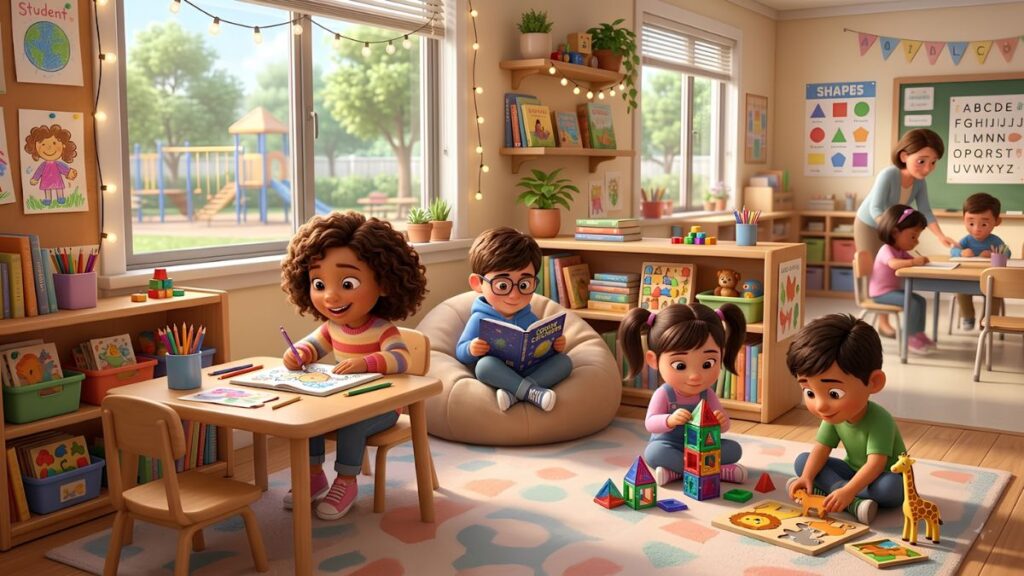
In every classroom, some students finish their assigned work before others. These moments can be challenging because early finishers need something meaningful to do while the rest of the class continues working.
Simply giving students extra worksheets is not always the best solution. Early-finisher activities should ideally be quiet, independent, engaging, and educational. They should allow students to continue learning without interrupting classmates who are still completing their work.
A well-planned collection of quiet time activities for early finishers can help teachers maintain a calm classroom while giving students opportunities to read, write, solve problems, create, review skills, and explore their interests.
Why Quiet Time Activities Are Important
Early finishers often have several choices once they complete their assigned work.
Without clear expectations, they may:
- Talk to classmates
- Walk around the classroom
- Interrupt the teacher
- Distract students who are still working
- Finish work too quickly just to reach free time
- Become bored
A structured early-finisher system gives students a clear answer to:
“What should I do when I finish my work?”
Good quiet activities can help students:
- Practice independence
- Develop concentration
- Strengthen academic skills
- Explore creativity
- Build reading habits
- Improve problem-solving
- Develop self-management
- Use classroom time productively
What Makes a Good Early-Finisher Activity?
Not every activity is appropriate for quiet classroom time.
A good activity should generally be:
- Quiet: It should not require students to talk loudly or move around the room.
- Independent: Students should be able to understand and complete it without constant teacher assistance.
- Engaging: The activity should be interesting enough that students actually want to do it.
- Flexible: It should work whether a student has five minutes or twenty minutes.
- Educational: The activity should provide meaningful practice or enrichment.
- Easy to Access: Students should know exactly where to find it.
Quiet Time Activities for Early Finishers
When students finish their work early, having quiet activities ready can keep them engaged without disrupting the classroom. Explore simple, meaningful quiet time activities that encourage reading, creativity, problem-solving, and independent learning.
Independent Reading
Independent reading is one of the simplest and most useful early-finisher activities.
Create a classroom reading area containing:
- Picture books
- Short chapter books
- Nonfiction books
- Magazines
- Poetry books
- Age-appropriate comics
- Student-selected reading materials
When students finish their work, they can choose a book and read quietly.
This activity is especially useful because it does not require additional worksheets or complicated preparation.
Drawing and Sketching
Drawing can provide a quiet creative activity.
Students can:
- Draw an imaginary animal
- Design a house
- Sketch a landscape
- Draw a classroom scene
- Create a comic
- Illustrate a story
- Design a robot
- Draw something they learned in class
Give students a dedicated drawing notebook so that their artwork does not become scattered across loose sheets of paper.
Writing Prompts
Keep a collection of simple writing prompts for early finishers.
Examples include:
- If I could invent anything, I would invent…
- My perfect weekend would be…
- If animals could talk…
- A mysterious box appeared at my door…
- The best place to explore would be…
- If I were invisible for one day…
- My dream classroom would have…
Students can write for five or ten minutes without needing a complete story.
Quiet Journaling
A classroom journal can become a regular early-finisher activity.
Students might write about:
- Something they learned
- Something they enjoyed
- A question they have
- Something they want to improve
- A book they are reading
- An interesting idea
- A personal goal
Journaling can also help students develop writing fluency.
Word Searches
Word searches are useful for quiet independent practice.
Teachers can create word searches based on:
- Vocabulary
- Science terms
- Spelling words
- Sight words
- Animals
- Geography
- Seasonal topics
Keep completed and unused puzzles in an early-finisher folder.
Crossword Puzzles
Crossword puzzles encourage students to think about vocabulary and definitions.
They can be especially useful after introducing a new topic.
For example, a science unit on plants could include terms such as:
- Root
- Stem
- Leaf
- Flower
- Seed
Students review vocabulary while completing an independent activity.
Sudoku and Logic Puzzles
Age-appropriate logic puzzles can be excellent enrichment activities.
Depending on the age group, students can work with:
- Simple Sudoku
- Number patterns
- Logic grids
- Matching puzzles
- Classification puzzles
- Visual reasoning puzzles
These activities encourage students to think rather than simply complete repetitive work.
Math Fact Practice
Early finishers can practice basic math facts quietly.
Activities might include:
- Addition facts
- Subtraction facts
- Multiplication facts
- Division facts
- Number patterns
- Mental math challenges
However, avoid making every early-finisher activity additional academic work. Students should have a balance of practice and enrichment.
Math Challenge Cards
Create a small box of challenge cards.
Each card can contain one problem.
Examples:
“I am thinking of a number greater than 20 but less than 40. It is even and divisible by 3. What could it be?”
Or:
“Can you find three different ways to make 24?”
These challenges encourage reasoning rather than repetitive calculation.
Pattern Activities
Pattern activities are suitable for younger students.
Children can:
- Continue number patterns
- Create shape patterns
- Identify missing items
- Design their own patterns
- Explain the rule
For example:
2, 4, 6, 8, ___
Students determine what comes next.
More advanced students can work with increasingly complex patterns.
Coloring With a Purpose
Coloring does not always have to be purely recreational.
Use:
- Mandala-style designs
- Math coloring pages
- Vocabulary coloring
- Science diagrams
- Geography maps
- Pattern coloring
For younger students, coloring can also provide quiet fine-motor practice.
Origami
Simple origami activities can keep students quietly engaged.
Start with easy designs such as:
- Paper boats
- Simple animals
- Bookmarks
- Flowers
- Paper airplanes
Provide clear visual instructions.
Origami can develop:
- Following directions
- Spatial awareness
- Fine-motor skills
- Patience
- Concentration
Bookmark Making
Students can create bookmarks when they finish early.
They can:
- Draw a design
- Write a favorite quote
- Add vocabulary words
- Illustrate a book character
- Create a reading goal
This is especially appropriate for classrooms that emphasize independent reading.
Create a Comic Strip
Give students a blank comic-strip template.
They can create:
- A funny story
- A science comic
- A historical scene
- A fictional adventure
- A conversation between animals
Comic creation combines writing, drawing, sequencing, and creativity.
Make a Mini Book
Students can create a small booklet.
For example:
My Favorite Animal
- Page 1: Title
- Page 2: Appearance
- Page 3: Habitat
- Page 4: Food
- Page 5: Interesting facts
This can be completed gradually over several early-finisher sessions.
Vocabulary Activities
Create vocabulary cards using words students are currently learning.
Students can:
- Write definitions
- Draw pictures
- Use words in sentences
- Find synonyms
- Find antonyms
- Sort words into categories
This provides useful review without requiring teacher assistance.
Sight Word Practice
For younger students, early-finisher time can be used for independent sight-word activities.
Students can:
- Read sight-word cards
- Write words
- Sort words
- Find words in books
- Create sentences
- Practice spelling
Keep the activity simple enough for students to complete independently.
Reading Response Activities
Students can respond to their independent reading.
Provide prompts such as:
- What happened in the story?
- Who was your favorite character?
- What was the main problem?
- What would you change?
- What do you predict will happen next?
- What was the most interesting fact?
These activities encourage deeper reading rather than simply turning pages.
Fact-of-the-Day Research
Create a collection of simple research questions.
For example:
- Why do birds have feathers?
- How do bees make honey?
- Why does the Moon appear to change shape?
- How do plants absorb water?
Students can research using approved classroom resources and record a few facts.
For younger students, provide books or printed information rather than requiring independent internet research.
“Did You Know?” Cards
Create cards containing interesting facts.
Students can read a card and then:
- Draw the subject
- Write one additional fact
- Explain what surprised them
- Create a question about it
This provides short, flexible activities for students who have only a few minutes.
Classroom Puzzle Box
Create a box containing reusable puzzles.
It might include:
- Jigsaw puzzles
- Tangrams
- Pattern blocks
- Matching puzzles
- Logic puzzles
- Word puzzles
Choose activities that can be completed quietly and independently.
Tangram Challenges
Tangrams are excellent for quiet problem-solving.
Give students a set of shapes and challenge them to create:
- Animals
- Objects
- Geometric designs
- Letters
- Silhouettes
You can provide challenge cards showing shapes students need to recreate.
Build With Pattern Blocks
Pattern blocks can be used for quiet creative activities.
Students can create:
- Animals
- Flowers
- Buildings
- Symmetrical designs
- Geometric patterns
Ask students to record or draw their final design if you want the activity to produce a lasting piece of work.
STEM Challenge Cards
Short STEM challenges can be excellent enrichment activities.
Examples:
- Design a bridge using paper.
- Build the tallest structure using classroom materials.
- Design a container that protects an object.
- Create a paper structure that supports several books.
For quiet time, choose challenges that do not require large amounts of movement or collaboration.
Design a Board Game
Students can create their own simple board game.
They might design:
- The board
- Rules
- Game pieces
- Questions
- Scoring system
The project can be completed gradually over several early-finisher sessions.
Create a Crossword Puzzle
Instead of solving a crossword, students can create one.
Ask them to choose several vocabulary words and write clues for each.
This encourages them to think about definitions and word relationships.
Make a Word Ladder
Word ladders require students to change one letter at a time to create new words.
For example:
CAT
↓
COT
↓
DOT
Students can create their own ladders once they understand the rules.
Quiet Observation Activities
Give students a small observation task.
For example:
“Find five different shapes in the classroom.”
Or:
“Look outside and write down three things you notice.”
Students can record their observations in a notebook.
This encourages attention to detail.
Gratitude or Positive Notes
Students can write a short positive note about:
- A classmate
- A teacher
- Someone who helped them
- Something they appreciate
If this activity is used, establish clear rules about respectful language and when notes can be delivered.
Goal-Setting Activities
Students can use quiet time to reflect on personal academic goals.
For example:
- This week I want to improve…
- One thing I already do well is…
- Something I want to learn is…
This encourages self-reflection and independence.
Quiet Coloring and Puzzle Books
Keep a few activity books available for students who finish early.
They might include:
- Mazes
- Dot-to-dot
- Coloring
- Word searches
- Number puzzles
- Spot-the-difference activities
These are particularly useful for younger students.
Create a Quiet Reading Corner
A designated reading area can make early-finisher time easier to manage.
Include:
- Comfortable seating
- Clearly organized books
- Reading logs
- Bookmarks
- Reading-response cards
Establish a simple rule:
If you finish your work, you may choose a book and read quietly.
Create an Early-Finisher Menu
Instead of allowing students to repeatedly ask, “What can I do?”, create a menu.
For example:
Early-Finisher Menu
- Read: Choose a book.
- Write: Complete a journal prompt.
- Create: Draw or make a comic.
- Think: Complete a puzzle.
- Practice: Review vocabulary or math facts.
- Explore: Read a nonfiction book.
Students can select an activity independently.
Use a “Must Do, May Do” System
This is a useful classroom structure.
Must Do
Students must first:
- Complete the assigned work.
- Check their answers.
- Correct mistakes if required.
May Do
Once the required work is complete, students may:
- Read
- Draw
- Write
- Solve puzzles
- Complete enrichment activities
This helps prevent students from rushing through required work just to access free-choice activities.
Create Activity Bins
Prepare several labeled bins.
- Bin 1 – Reading: Books and reading-response cards.
- Bin 2 – Writing: Journals and writing prompts.
- Bin 3 – Math: Puzzles and challenge cards.
- Bin 4 – Creativity: Drawing and craft activities.
- Bin 5 – STEM: Simple building and design challenges.
Students can select an activity without asking the teacher.
Rotate Activities Regularly
Students may become bored if the same early-finisher materials are available all year.
You can rotate activities every few weeks.
For example:
- Week 1: Reading and puzzles
- Week 2: Writing and drawing
- Week 3: STEM challenges
- Week 4: Vocabulary and math games
This keeps the system fresh without requiring completely new materials every day.
Set Clear Quiet-Time Expectations
Before introducing early-finisher activities, teach students the rules.
For example:
- Finish the assigned work.
- Check your work.
- Choose one approved activity.
- Work quietly.
- Stay in your assigned area.
- Clean up before changing activities.
- Do not interrupt students who are still working.
- Return materials when finished.
Students are more likely to use the system successfully when expectations are explicit.
Avoid Making Early Finishers Feel Punished
Early-finisher activities should not feel like punishment for completing work quickly.
Avoid automatically giving students:
“More worksheets because you finished.”
Instead, provide a mixture of:
- Reading
- Creativity
- Puzzles
- Exploration
- Academic enrichment
- Reflection
This makes early-finisher time something students can look forward to.
Avoid Rewarding Only Speed
One potential problem is encouraging students to rush.
Students may begin submitting incomplete or careless work because they want access to the early-finisher activities.
To avoid this, make the first requirement: Finish carefully, then check your work.
Quality should matter more than speed.
Match Activities to the Age Group
Kindergarten
Good choices include:
- Picture books
- Coloring
- Letter puzzles
- Simple tracing
- Drawing
- Pattern activities
- Matching games
Elementary School
Try:
- Reading
- Writing prompts
- Word puzzles
- Math challenges
- Drawing
- STEM challenges
- Research cards
Middle School
Consider:
- Independent reading
- Logic puzzles
- Journaling
- Creative writing
- Research questions
- Subject-specific challenges
- Design projects
Activities should become increasingly independent and intellectually challenging as students get older.
How Much Time Should Early-Finisher Activities Take?
There is no single required duration.
Some students may have:
5 minutes: while others may have:
20 minutes: Choose activities that can be stopped and resumed easily.
For example, reading, drawing, puzzles, and journaling work well because students can pause them without losing significant progress.
Long activities can be divided into multiple sessions.
Track Long-Term Projects
For activities such as:
- Mini books
- Board games
- Research projects
- STEM designs
- Creative writing
give each student a folder or project envelope.
Students can return to the project whenever they finish early.
This prevents unfinished projects from getting lost.
Create a Quiet Time Routine
A predictable routine can make the system work smoothly.
For example:
- Finish assigned work.
- Check your work.
- Put your work in the correct tray.
- Choose an early-finisher activity.
- Work quietly.
- Clean up when instructed.
Once students learn this routine, the teacher should receive fewer interruptions.
Sample Early-Finisher Menu
You could display the following in the classroom:
When You Finish Early
- Read: Choose a book and read quietly.
- Write: Choose a journal prompt.
- Think: Complete a puzzle or brain teaser.
- Create: Draw, design, or make a comic.
- Practice: Review vocabulary or math facts.
- Explore: Read a nonfiction book or complete a research card.
- Build: Complete a quiet STEM or design challenge.
Final Thoughts
Quiet time activities for early finishers can turn an otherwise difficult classroom moment into an opportunity for independent learning.
The most effective system does not simply give students more work. Instead, it offers a balanced selection of reading, writing, puzzles, creativity, academic practice, problem-solving, and exploration.
A simple Must Do, May Do routine can be especially effective. Students first complete their assigned work carefully, check it, and then choose an approved quiet activity.
Teachers can make the system even easier by creating early-finisher menus, activity bins, reading corners, challenge cards, and project folders. Activities should be easy to start, quiet enough not to disturb classmates, and flexible enough to work whether students have five minutes or twenty.
Most importantly, early-finishers should learn that finishing their work does not mean “free time to disturb others.” It means they have earned an opportunity to read, create, explore, practice, and learn independently while respecting the learning environment around them.
