
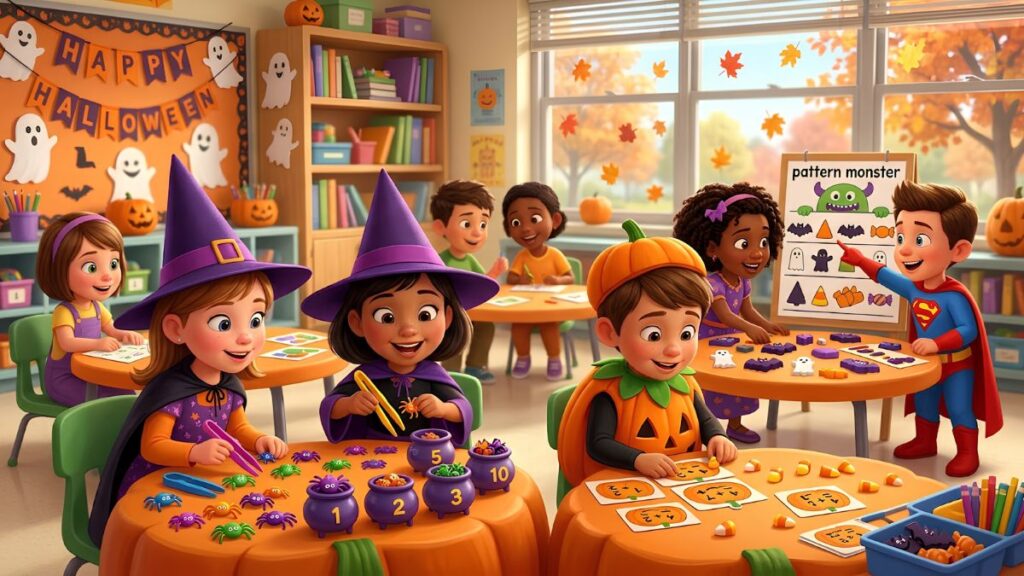
Halloween is a fun time to bring seasonal excitement into the classroom while continuing to build important first-grade math skills. Teachers can use Fun Halloween Math Activities for 1st Grade to combine seasonal themes with meaningful practice instead of treating Halloween activities as something separate from learning.
Pumpkins, bats, ghosts, spiders, candy corn, costumes, and haunted houses can all become themes for practicing everyday math concepts.
First graders are typically developing skills such as counting, addition and subtraction, comparing numbers, understanding place value, recognizing shapes, identifying patterns, measuring objects, and interpreting simple data. Halloween-themed activities can give students a playful context in which to practice these skills.
The best Fun Halloween Math Activities for 1st Grade should remain simple, hands-on, and focused on one or two learning objectives at a time. This helps students enjoy the seasonal theme while still building essential math skills.
Why Use Halloween Math Activities in 1st Grade?
Young children often learn more enthusiastically when lessons connect with familiar and exciting themes. Halloween provides plenty of visual and practical opportunities for math.
For example, a teacher can turn:
- Pumpkins into counting objects
- Bats into pattern cards
- Ghosts into addition counters
- Spiders into subtraction manipulatives
- Halloween candy pictures into graphing data
- Haunted houses into shape activities
- Costumes into sorting activities
These activities can help reinforce mathematical concepts while also encouraging students to explain their thinking and work with classmates.
Fun Halloween Math Activities for 1st Grade
Make math more exciting this Halloween with playful, hands-on activities designed for first graders. Explore fun ways to practice counting, addition, subtraction, patterns, shapes, and problem-solving with a spooky seasonal twist.
Pumpkin Counting Activity
Counting is one of the simplest ways to introduce Halloween math.
Prepare paper pumpkins numbered from 1 to 20. Mix them up and ask students to arrange them in numerical order.
Then remove several pumpkins.
For example:
1, 2, __, 4, 5, __, 7
Ask students to identify the missing numbers.
Extension Activity
Give students a pile of pumpkin counters and a number card.
If the card shows:
14
students must count out exactly 14 pumpkins.
Then ask:
- How many pumpkins did you count?
- What number comes before 14?
- What number comes after 14?
- How many more pumpkins would you need to make 20?
This turns basic counting into broader number-sense practice.
Pumpkin Ten-Frame Challenge
Ten frames help children understand numbers in relation to 10.
Create Halloween-themed ten frames containing pumpkins.
For example:
🎃 🎃 🎃 🎃 🎃 🎃
Ask:
“How many pumpkins are there?”
Then ask:
“How many more pumpkins would make 10?”
The student should recognize that:
6 + 4 = 10
You can gradually increase the challenge by using numbers up to 20 with two ten frames.
Halloween Number Bonds
Create pumpkin-shaped number bonds.
For example: 8
is the whole number.
The two parts could be: 5 + 3
Ask students to complete: 5 + ___ = 8
or: ___ + 3 = 8
This helps students understand that numbers can be broken into smaller parts.
Pumpkin Addition With Counters
Use small pumpkin cutouts as manipulatives.
Give students: 4 pumpkins
Then add: 3 more pumpkins
Ask: “How many pumpkins do we have altogether?”
Students physically combine the groups.
Then write: 4 + 3 = 7
This is especially useful for children who benefit from seeing and touching quantities before moving to abstract equations.
Ghost Addition
Create ghost cards with simple addition equations.
For example:
3 + 4 = ___
5 + 2 = ___
6 + 3 = ___
Students can solve each equation using counters, drawings, or a number line.
Make It More Interactive
Place several ghost cards around the classroom.
Students walk to each ghost, solve the problem, and record the answer on a Halloween math recording sheet.
Spider Subtraction
Create a group of paper spiders.
Start with: 9 spiders
Tell students: “Three spiders crawled away.”
Students remove three spiders.
Then ask: “How many spiders are left?”
They can write: 9 – 3 = 6
This gives subtraction a visual context.
Halloween Subtraction Number Line
Give students a Halloween-themed number line from 0 to 20.
For: 12 – 4
students start at 12 and move backward four spaces.
They land on: 8
This helps connect subtraction with movement along a number sequence.
Halloween Addition and Subtraction Stories
Word problems can become more approachable when they involve familiar Halloween objects.
Example
Liam has 7 pumpkins. His teacher gives him 4 more. How many pumpkins does Liam have now?
Students can:
- Draw 7 pumpkins.
- Draw 4 more.
- Count them.
- Write the equation.
7 + 4 = 11
For subtraction:
There are 10 bats hanging in a classroom. 3 bats fall down. How many bats are still hanging?
10 – 3 = 7
Encourage students to represent the problem visually before writing the equation.
Halloween Fact Families
Use three numbers to create related addition and subtraction facts.
For example: 4, 5, 9
Students can create:
- 4 + 5 = 9
- 5 + 4 = 9
- 9 – 4 = 5
- 9 – 5 = 4
Decorate the fact-family template with pumpkins or ghosts.
This helps students see the relationship between addition and subtraction.
Halloween Number Comparison
Prepare cards with numbers from 1 to 20.
Give students two cards.
For example: 8 and 15
Ask: “Which number is greater?”
Students can write: 8 < 15
Use Halloween pictures to make the comparison concrete.
For example:
🎃 🎃 🎃 🎃
versus
🎃 🎃 🎃 🎃 🎃 🎃 🎃
Ask:
“Which group has more pumpkins?”
More, Less, or Equal
Create two Halloween groups.
For example:
Group A:
🦇 🦇 🦇 🦇 🦇
Group B:
🦇 🦇 🦇
Ask students to identify:
Group A has more.
Group B has fewer.
Then create equal groups.
5 bats = 5 bats
Ask: “Are the groups equal?”
This builds vocabulary that students can later connect with mathematical symbols.
Halloween Missing Number Challenge
Create number sequences with missing numbers.
- Easy: 1, 2, __, 4, 5
- Medium: 7, 8, __, 10, 11
- More Challenging: 12, __, 14, __, 16
Ask students to explain how they know which numbers are missing.
Count by 2s With Bats
Use bat cards labeled:
2, 4, 6, 8, 10, 12, 14, 16, 18, 20
Students place them in order.
Then practice saying the sequence aloud.
Ask:
- “What comes after 12?”
- “What comes before 18?”
You can also remove cards and ask students to identify the missing number.
Count by 5s With Pumpkins
Create pumpkin cards labeled:
5, 10, 15, 20, 25, 30
Students arrange them in order and count aloud.
For first graders who are just beginning skip counting, start with smaller numbers.
Halloween Pattern Practice
Patterns are an important early mathematical skill.
Create:
🎃 👻 🎃 👻 🎃 __
Students identify the missing ghost.
Then make more complicated patterns:
🦇 🎃 👻 🦇 🎃 👻 __
Students identify the repeating sequence.
Challenge
Ask students to create their own pattern and have a partner figure out what comes next.
Halloween Shape Hunt
Turn the classroom into a geometry activity.
Ask students to look for:
- Circles
- Squares
- Rectangles
- Triangles
They can record their findings on a worksheet.
For example:
- Circle: pumpkin
- Rectangle: classroom door
- Triangle: witch’s hat
- Square: decoration
Ask students to explain why an object belongs to a particular shape category.
Build a Haunted House With Shapes
Give students paper shapes.
Ask them to create a haunted house using:
- Squares
- Rectangles
- Triangles
- Circles
After completing the picture, ask:
- “How many triangles did you use?”
- “How many rectangles?”
- “Which shape did you use the most?”
This combines geometry with counting.
Halloween Graphing Activity
Create a class graph based on students’ favorite Halloween symbols.
Give each student one choice:
🎃 Pumpkin
👻 Ghost
🦇 Bat
🕷️ Spider
Record the responses on a simple bar graph.
Then ask questions such as:
- Which symbol is most popular?
- Which is least popular?
- How many students chose pumpkins?
- How many students chose ghosts?
- How many more students chose bats than spiders?
This introduces students to collecting and interpreting data.
Halloween Survey
Students can conduct a simple survey with classmates.
Ask: “Which Halloween activity do you like best?”
Choices could include:
- Pumpkin decorating
- Costume day
- Halloween crafts
- Halloween games
Students record responses using tally marks.
Then turn the results into a simple graph.
This gives students practice with tallying, counting, comparing, and interpreting data.
Halloween Dice Addition
Give each student two dice.
Students roll both dice and add the numbers.
For example: 5 + 4 = 9
They record the equation on their worksheet.
Challenge
Ask students to roll three times and determine: Which sum was the greatest?
This adds comparison practice.
Halloween Dice Subtraction
Students roll two dice.
Use the larger number as the starting number.
For example: 6 and 2
Write: 6 – 2 = 4
Students can use counters or a number line if needed.
Pumpkin Measurement
Give students paper pumpkins of different sizes.
Ask:
- Which pumpkin is longer?
- Which is shorter?
Then introduce non-standard measurement.
Students can measure pumpkins using:
- Linking cubes
- Paper clips
- Blocks
- Pencils
For example: “My pumpkin is 9 cubes long.”
This introduces measurement without requiring standard rulers.
Halloween Weight Comparison
Use safe classroom objects representing Halloween items.
Ask students to predict which is:
- Heavier
- Lighter
- About the same
If a balance scale is available, students can test their predictions.
Ask: “Were you correct?”
This introduces measurement and estimation.
Halloween Sorting
Give students Halloween pictures and ask them to sort them according to a particular characteristic.
For example:
By Size
- Small pumpkins
- Large pumpkins
By Shape
- Round objects
- Long objects
By Type
- Bats
- Ghosts
- Pumpkins
- Spiders
Ask students to explain their sorting rule.
Halloween Number Mystery
Give students clues to identify a mystery number.
For example:
- My number is greater than 10.
- My number is less than 15.
- My number is even.
The answer is: 12 or 14
Add another clue: My number is greater than 12.
Now the answer is: 14
This encourages logical thinking and number comparison.
Haunted House Math Maze
Create a maze decorated like a haunted house.
Each section contains a math problem.
For example: 5 + 3 = ?
Students solve the problem and follow the path marked with the correct answer.
The next problem might be: 10 – 4 = ?
The goal is to reach the haunted house at the end.
This can be used as an individual activity, partner game, or math center.
Halloween Math Task Cards
Create a collection of cards with one question on each card.
Examples:
- What is 6 + 3?
- What number comes after 17?
- Which is greater: 9 or 13?
- How many sides does a triangle have?
- What is 10 – 4?
Students can solve the cards at their own pace.
Halloween Math Centers
A classroom can be divided into several activity stations.
- Center 1: Pumpkin Addition – Use pumpkin counters to solve addition problems.
- Center 2: Spider Subtraction – Solve subtraction equations using spider counters.
- Center 3: Bat Patterns – Complete Halloween patterns.
- Center 4: Shape Hunt – Identify and count shapes.
- Center 5: Halloween Graph – Collect and interpret class data.
- Center 6: Number Comparison – Compare Halloween-themed number cards.
Rotating through centers gives students repeated practice without requiring them to sit with one worksheet for an extended period.
Halloween Math Bingo
Create bingo cards containing numbers.
Instead of calling numbers directly, call equations.
For example: 4 + 3
Students calculate: 7
Then cover 7 if it appears on their card.
For subtraction: 10 – 2
Students find: 8
This provides repeated practice with basic facts.
Halloween Memory Match
Create matching cards.
One card contains: 5 + 3
The matching card contains: 8
Students turn over two cards at a time and try to find the correct pair.
For children who need additional support, use picture representations alongside equations.
Halloween Math Scavenger Hunt
Place math questions around the classroom.
For example:
Station 1
4 + 2 = ?
Answer: 6
Go to station 6.
Station 6
9 – 3 = ?
Answer: 6
Continue until students reach the final Halloween-themed station.
This combines movement, problem-solving, and computation.
Halloween Math Book
Students can create a small Halloween math booklet.
- Page 1: Count the pumpkins.
- Page 2: Solve the addition problems.
- Page 3: Solve the subtraction problems.
- Page 4: Complete the patterns.
- Page 5: Identify the shapes.
- Page 6: Solve a Halloween word problem.
Students can illustrate each page with their own Halloween drawings.
Halloween Math Journal
Instead of only solving equations, ask students to explain their thinking.
For example: “I had 6 pumpkins and added 3. How did I find the answer?”
A student might draw:
🎃 🎃 🎃 🎃 🎃 🎃
🎃 🎃 🎃
=
9
Then write: “I counted all the pumpkins.”
This encourages mathematical communication.
Halloween Estimation Jar
Fill a transparent container with Halloween-themed counters, such as paper pumpkins or plastic spiders.
Ask: “How many do you think are in the jar?”
Each student records a guess.
Then count them together.
Ask: “Who was closest?”
This introduces estimation and encourages children to make reasonable mathematical predictions.
Halloween One-More and One-Less
Give students a number card.
For example: 12
Ask:
“What is one more?”
13
Then:
“What is one less?”
11
Use pumpkin cards or a number line to help children visualize the relationships.
Halloween Number Building
Give students a two-digit number such as: 24
Ask:
“How many tens?”
2 tens
“How many ones?”
4 ones
Students can build the number using base-ten blocks.
Then ask: “What number is one more?”
25
This introduces place-value concepts in a seasonal context.
Halloween Partner Games
Pair students together.
One student draws a number card.
The other draws a second card.
Together they create an addition equation.
For example: 5 + 7 = 12
Then switch roles.
For subtraction, students can use the larger number first: 9 – 4 = 5
Partners can check each other’s answers.
Halloween Exit Tickets
At the end of a math lesson, give students one or two questions.
For example:
Solve: 8 + 4 = ___
Circle the greater number: 11 or 15
Or:
Draw a group of 7 pumpkins.
Exit tickets provide a quick way to see which students understand the concept and which students may need additional practice.
How to Differentiate Halloween Math Activities
Not every first grader will have the same level of mathematical understanding. The same activity can be adjusted without creating an entirely different lesson.
For Students Who Need More Support
Use:
- Smaller numbers
- Physical counters
- Number lines
- Ten frames
- Visual examples
- Partner support
For Students Ready for More Challenge
Ask them to:
- Work with larger numbers
- Create their own equations
- Explain their strategies
- Solve multi-step problems
- Create word problems
- Find multiple solutions
For example, instead of:
5 + 3 = ?
ask:
“Find two different addition equations that equal 8.”
Possible answers include:
5 + 3 = 8
6 + 2 = 8
Tips for Using Halloween Math Activities in the Classroom
Choose the Math Skill First
Before designing the Halloween activity, decide what students need to practice.
For example:
Learning goal: Addition within 20
Theme: Pumpkins
Then create an activity that supports that specific goal.
Use Simple Materials
You do not need expensive Halloween decorations.
Useful materials include:
- Paper cutouts
- Dice
- Counters
- Linking cubes
- Number cards
- Printable worksheets
- Pencils
- Crayons
- Ten frames
- Number lines
Keep Directions Short
First graders benefit from simple, direct instructions.
Instead of explaining an activity for several minutes, demonstrate one example and let students begin.
Let Students Explain Their Thinking
Do not focus only on whether the final answer is correct.
Ask:
- “How did you solve it?”
- “What did you do first?”
- “Can you show your answer another way?”
These questions help develop mathematical reasoning.
Avoid Making Every Activity Competitive
Games can be fun, but students do not always need to compete.
Cooperative activities can allow children to solve problems together and discuss strategies without the pressure of being the fastest.
Sample Halloween Math Lesson Plan
A 45- to 60-minute lesson could look like this:
- 5 Minutes: Warm-Up – Count forward and backward using a Halloween number line.
- 10 Minutes: Teacher Instruction – Model addition using pumpkin counters.
- 10 Minutes: Guided Practice – Students solve pumpkin addition problems with partners.
- 15 Minutes: Math Center – Students complete a Halloween addition game.
- 5 Minutes: Independent Practice – Students solve three or four problems individually.
- 5 Minutes: Exit Ticket – Students solve one addition problem and explain how they found the answer.
This structure provides a balance between instruction, hands-on practice, independent work, and assessment.
Final Thoughts
Fun Halloween math activities for 1st grade can make important mathematical concepts more engaging without sacrificing instructional value. Pumpkins can become counting and addition manipulatives, spiders can support subtraction, bats can represent patterns, and haunted houses can provide a setting for shape and problem-solving activities.
The strongest activities combine hands-on materials, visual representations, mathematical language, and opportunities for students to explain their thinking. Teachers can also differentiate each activity by adjusting the numbers, amount of support, and level of reasoning required.
Whether you are planning a Halloween math center, a special classroom activity, a printable worksheet, or an entire themed math day, the goal should remain the same: use the Halloween theme to make math memorable while giving first graders meaningful opportunities to practice and understand essential math skills.
