
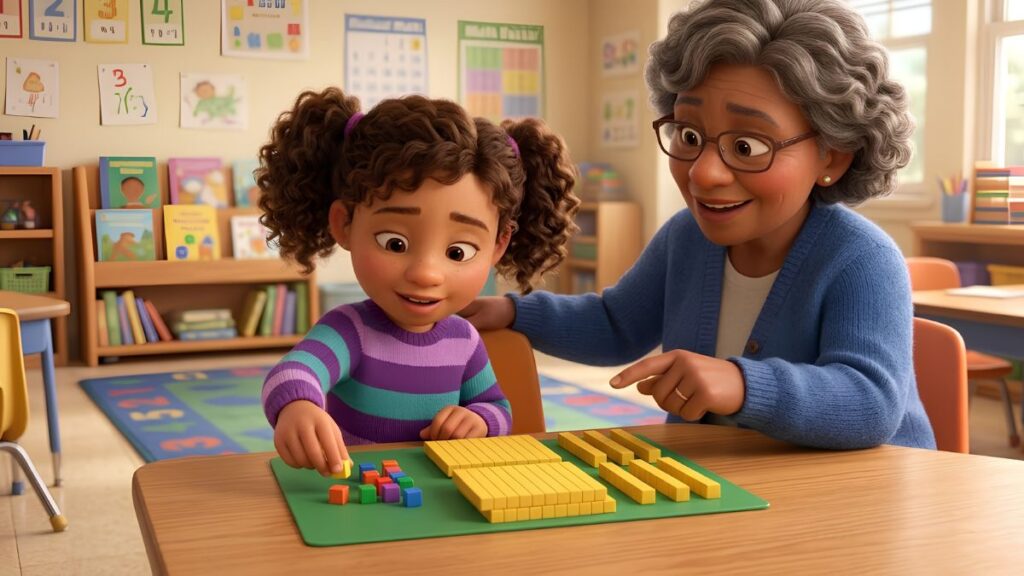
Teaching place value with base ten blocks gives children a hands-on way to understand how numbers are organized. Instead of memorizing that a digit in the tens place represents groups of ten, students can physically build those groups and see how different pieces represent different values.
Place value is a foundation for many later math skills, including addition, subtraction, multiplication, division, rounding, decimals, and working with larger numbers. A strong understanding of place value can therefore make many future math concepts easier.
The central idea students should eventually understand is:
10 ones = 1 ten
10 tens = 1 hundred
10 hundreds = 1 thousand
What Are Base Ten Blocks?
Base ten blocks are manipulatives that represent the structure of our base-ten number system.
The standard pieces include:
Unit Cube
Represents: 1
It is used for the ones place.
Ten Rod
Represents: 10
It is made up of 10 unit cubes and represents one ten.
Hundred Flat
Represents: 100
It contains 10 ten rods and represents one hundred.
Thousand Cube
Represents: 1,000
It contains 10 hundred flats and represents one thousand.
The repeating relationship between the pieces is the most important part:
10 unit cubes → 1 ten rod
10 ten rods → 1 hundred flat
10 hundred flats → 1 thousand cube
Why Use Base Ten Blocks to Teach Place Value?
Place value is an abstract concept. A child may be able to repeat that “the 5 in 50 means five tens” without actually understanding what five tens represents.
Base ten blocks make that idea visible.
For example, place: 5 unit cubes
beside: 5 ten rods
Ask the student whether the two groups have the same value.
The student can see that one represents: 5
while the other represents: 50
This helps demonstrate that the position of a digit changes its value.
Teaching Place Value With Base Ten Blocks
Understanding place value becomes much easier when children can see and touch what each digit represents. Teaching Place Value With Base Ten Blocks gives students a hands-on way to explore ones, tens, and hundreds while building a stronger understanding of how numbers are structured.
Begin With Exploration
Before formally teaching place value, allow students to explore the blocks.
Give them a collection of unit cubes, ten rods, and hundred flats.
Ask questions such as:
- Which piece is smallest?
- Which piece is largest?
- How many small cubes make one rod?
- How many rods make one flat?
- Can you find pieces that represent the same amount?
- What happens when you put 10 small cubes together?
Allow students to touch, count, compare, and arrange the blocks.
This creates an intuitive understanding before introducing mathematical vocabulary.
Introduce Ones
Begin with the smallest unit.
Hold up one cube and explain: “This represents one.”
Give students several cubes and ask them to build:
- 2
- 4
- 6
- 9
Have students count each cube individually.
Then ask: “What place do these cubes represent?”
Introduce the word: ones
Explain that each individual cube represents one unit or one one.
Introduce Tens
Place one ten rod beside 10 individual unit cubes.
Count the cubes together: 1, 2, 3, 4, 5, 6, 7, 8, 9, 10
Then point to the rod.
Explain: “These 10 ones have the same value as one ten.”
Write: 10 ones = 1 ten
This is an important moment. Give students time to physically compare the two representations.
Let Students Make Their Own Tens
Give each student 10 unit cubes.
Ask: “Can you make one group of ten?”
After they count the cubes, let them exchange the 10 cubes for a ten rod.
Repeat the activity several times.
For example:
- 20 ones = 2 tens
- 30 ones = 3 tens
- 40 ones = 4 tens
This builds a connection between counting by ones and counting by tens.
Introduce Hundreds
Once students understand tens, introduce the hundred flat.
Show: 10 ten rods
and: 1 hundred flat
Explain: 10 tens = 1 hundred
Then connect all three levels: 100 ones = 10 tens = 1 hundred
Students should physically count and compare the blocks whenever possible.
Introduce Thousands When Appropriate
For students working with four-digit numbers, introduce the thousand cube.
Show 10 hundred flats and explain: 10 hundreds = 1 thousand
Then build the complete hierarchy:
- 1 one
- 1 ten = 10 ones
- 1 hundred = 10 tens
- 1 thousand = 10 hundreds
This shows students that the same grouping pattern continues as numbers become larger.
Create a Place Value Chart
Place a chart in front of students:
| Thousands | Hundreds | Tens | Ones |
|---|---|---|---|
Give students a number, such as: 3,426
Ask them to build it.
They should use:
- 3 thousand cubes
- 4 hundred flats
- 2 ten rods
- 6 unit cubes
Then place each type of block under its corresponding heading.
This connects the physical blocks to written place value.
Start With Two-Digit Numbers
Do not immediately begin with thousands.
Start with simple numbers such as: 23
Ask students: “How can we build 23?”
They should identify: 2 tens + 3 ones
Then try:
- 41
- 56
- 72
- 89
For every number, ask students to explain what each digit represents.
Move to Three-Digit Numbers
Once students understand tens and ones, introduce hundreds.
For example: 352
Build: 3 hundreds + 5 tens + 2 ones
Then ask: “What does the 3 represent?”
Answer: 300
“What does the 5 represent?”
Answer: 50
“What does the 2 represent?”
Answer: 2
This helps students move beyond simply identifying digits.
Teach the Difference Between a Digit and Its Value
This distinction is extremely important.
Consider: 444
The digit is 4 in all three positions, but the values are different.
The first 4 represents: 400
The second 4 represents: 40
The third 4 represents: 4
Use blocks to physically demonstrate the difference.
Ask: “Do these three 4s have the same value?”
Students should recognize that they do not.
Introduce Expanded Form
After students build a number, translate it into expanded form.
For: 352
the blocks show: 3 hundreds + 5 tens + 2 ones
Write: 352 = 300 + 50 + 2
Repeat with different numbers.
This creates a strong connection:
Physical blocks → Place value → Expanded form
Introduce Standard Form
Reverse the activity.
Tell students: “I have 4 hundreds, 3 tens, and 7 ones. What number did I build?”
Students combine the values: 400 + 30 + 7 = 437
Then write: 437
This gives them practice moving from place-value language to standard notation.
Introduce Word Form
Once students are comfortable with standard and expanded form, introduce word form.
For: 437
students can write: four hundred thirty-seven
Use all three representations together:
- Standard form: 437
- Expanded form: 400 + 30 + 7
- Word form: four hundred thirty-seven
The blocks provide the physical representation behind all three.
Teach Zero as a Placeholder
Zero often causes confusion.
Use: 305
Ask students to build it.
They need:
- 3 hundreds
- 0 tens
- 5 ones
There is no ten rod, but the tens position still exists.
Explain: “Zero tells us that there are no tens in this number.”
Without zero: 305
could incorrectly become: 35
This is why zero is important in place value.
Practice Numbers With Zeros
Give students several examples:
- 204
- 310
- 405
- 507
- 620
Ask them to build each number.
Then ask:
- How many hundreds?
- How many tens?
- How many ones?
- Why is there a zero?
- What would happen if we removed the zero?
This provides repeated practice with placeholder zeros.
Teach Comparing Numbers
Base ten blocks are excellent for teaching greater than and less than.
Build: 42
and: 35
Ask students which number is greater.
Instead of simply looking at the digits, have them compare: 4 tens vs. 3 tens
Because 4 tens are greater than 3 tens: 42 > 35
This teaches students to compare numbers by place value.
Teach Ordering Numbers
Give students three or four numbers.
For example:
- 124
- 142
- 214
Ask them to build each number.
Then arrange them from smallest to largest: 124, 142, 214
Students can compare the blocks at each place-value level.
Start with the hundreds, then tens, then ones when necessary.
Teach “10 More” and “10 Less”
Base ten blocks make this concept very visual.
Build: 36
Then ask: “What happens if we add one ten?”
Students add a ten rod: 36 + 10 = 46
Now remove one ten: 46 − 10 = 36
Practice with numbers such as:
- 25
- 47
- 63
- 81
This reinforces the value of the tens place.
Teach “100 More” and “100 Less”
Once students understand tens, extend the same concept to hundreds.
Build: 326
Add one hundred flat: 426
Therefore: 326 + 100 = 426
Remove one hundred: 426 − 100 = 326
This helps students recognize that moving one place value changes the number by a predictable amount.
Introduce Trading and Regrouping
Trading is one of the most valuable activities with base ten blocks.
Suppose a student has: 13 ones
Place 13 unit cubes in front of them.
Ask: “Can we trade 10 ones for something that has the same value?”
Trade: 10 ones → 1 ten
The student is left with: 1 ten + 3 ones
This represents: 13
This concrete experience prepares students for regrouping in addition and subtraction.
Use Blocks for Addition
Consider: 27 + 16
Build 27: 2 tens + 7 ones
Build 16: 1 ten + 6 ones
Combine: 3 tens + 13 ones
Now trade: 10 ones → 1 ten
The result becomes: 4 tens + 3 ones
Therefore: 27 + 16 = 43
Students can physically see why a new ten is created.
Use Blocks for Subtraction
Consider: 52 − 18
Build: 5 tens + 2 ones
Students need to remove 8 ones, but there are only 2 ones.
Trade: 1 ten → 10 ones
Now there are: 4 tens + 12 ones
Remove: 1 ten + 8 ones
The remaining blocks are: 3 tens + 4 ones
Therefore: 52 − 18 = 34
This makes the traditional borrowing or regrouping process much more meaningful.
Let Students Represent the Same Number in Different Ways
Ask: “Can you build 35 in two different ways?”
One representation is: 3 tens + 5 ones
Another could be: 2 tens + 15 ones
Students can trade one ten for 10 ones.
The total value remains: 35
This teaches that a number can have different physical representations while keeping the same value.
Use “Build It, Draw It, Write It”
This is a useful three-stage activity.
Build It
Students construct the number using blocks.
Draw It
Students draw the blocks on paper.
Write It
Students write the number in standard and expanded form.
For example:
- Build: 4 hundreds + 2 tens + 7 ones
- Draw: corresponding blocks
- Write: 427
- Expanded form: 400 + 20 + 7
This gradually moves students from hands-on learning toward abstract mathematics.
Use a Place Value Mystery Game
Give students clues.
For example:
- “I have 5 hundreds.”
- “I have 2 tens.”
- “I have 8 ones.”
Ask: “What number am I?”
Students build: 528
Then reverse the game.
Build a number and have students create clues for their classmates.
Play “What Changed?”
Build: 246
Then secretly change one block.
For example, replace: 4 tens
with: 5 tens
Ask: “What changed?”
Students should identify: The number increased by 10.
This develops place-value reasoning.
Use Place Value With Money
Money can provide another familiar context.
For example, use pretend money to discuss:
- Ones
- Tens
- Hundreds
- Thousands
A child can see that 5 groups of 10 represent 50.
While money does not exactly match the physical dimensions of base ten blocks, it can help reinforce the idea of grouping quantities.
Encourage Mathematical Language
Ask students to use complete explanations.
Instead of: “It’s 63.”
encourage: “The number is 63 because it has 6 tens and 3 ones.”
For a larger number: “The 7 is worth 700 because it is in the hundreds place.”
This helps children connect mathematical vocabulary to their reasoning.
Use Questions That Encourage Thinking
Good questions include:
- How many ones are in one ten?
- How many tens are in one hundred?
- What is the value of this digit?
- Why is this digit worth more than that one?
- Can you build the same number another way?
- What happens if we add one ten?
- What happens if we remove one hundred?
- Why do we need the zero?
- Which number is greater? How do you know?
- Can you explain your answer using the blocks?
These questions help students develop conceptual understanding.
Common Mistakes to Watch For
Confusing a Digit With Its Value
A child may say the 6 in 64 means 6 instead of 60.
Use the blocks to show six ten rods.
Counting Rods as Ones
Make sure students understand that one rod represents 10, not 1.
Ignoring Zero
Use numbers with missing place values regularly.
Comparing Only the Number of Digits
Explain that a three-digit number is not automatically greater in every comparison without considering the actual values.
Difficulty With Regrouping
Return to the physical trading activity.
Treating Blocks as Objects to Count Rather Than Values
Frequently ask: “How much is this block worth?”
rather than only: “How many blocks are there?”
Move From Concrete to Abstract
Base ten blocks should support understanding rather than become a permanent requirement for every calculation.
A useful progression is:
- Concrete: Physically manipulate blocks.
- Representational: Draw pictures of the blocks.
- Symbolic: Use numerals and place-value charts.
- Abstract: Solve problems mentally or with standard written methods.
If a student becomes confused at the abstract stage, return to the concrete model.
Use a Daily Place Value Warm-Up
A five-minute routine can provide consistent reinforcement.
Write: 4,582
Ask: How many thousands?
4
How many hundreds?
5
How many tens?
8
How many ones?
2
Then ask: What is the value of the 5?
500
What is 10 more?
4,592
What is 100 less?
4,482
This creates repeated exposure without requiring a full lesson every day.
Example 20-Minute Classroom Activity
First 5 Minutes
Review the value of the four types of blocks.
Next 5 Minutes
Call out numbers and have students build them.
Examples:
- 24
- 57
- 103
- 245
Next 5 Minutes
Students write the standard and expanded forms.
Final 5 Minutes
Ask comparison and reasoning questions.
For example: Which is greater, 245 or 254? Why?
This combines hands-on practice with mathematical reasoning.
Example Small-Group Activity
For students who need additional support, use a small group of three or four children.
Give each student a place-value mat and blocks.
Call out: “Build 62.”
Check their models.
Then ask: “Show me 10 more.”
Then: “Show me 10 less.”
Then: “Trade the tens and ones so you represent the same number differently.”
This creates several layers of practice from one number.
Assess Understanding Through Demonstration
A written worksheet does not always show whether a child understands place value.
Ask students to demonstrate: “Build 408.”
Then ask: “Why did you use zero tens?”
Or: “Build 260 in two different ways.”
Or: “Build 350 and then show me 100 more.”
These tasks require students to apply the concept rather than simply recognize an answer.
Final Thoughts
Base ten blocks provide a powerful way to make place value concrete and understandable. They allow children to see, touch, count, compare, combine, and trade quantities, which can make an abstract mathematical system much easier to understand.
Start with the simplest relationships:
1 unit = 1
10 units = 1 ten
10 tens = 1 hundred
10 hundreds = 1 thousand
Then gradually move into building numbers, expanded form, comparing numbers, zeros as placeholders, regrouping, addition, and subtraction.
The strongest approach is to move through three stages:
Build it → Draw it → Write it
Once students can comfortably move between these representations, they are better prepared to understand more advanced mathematical operations and work with numbers independently.
