
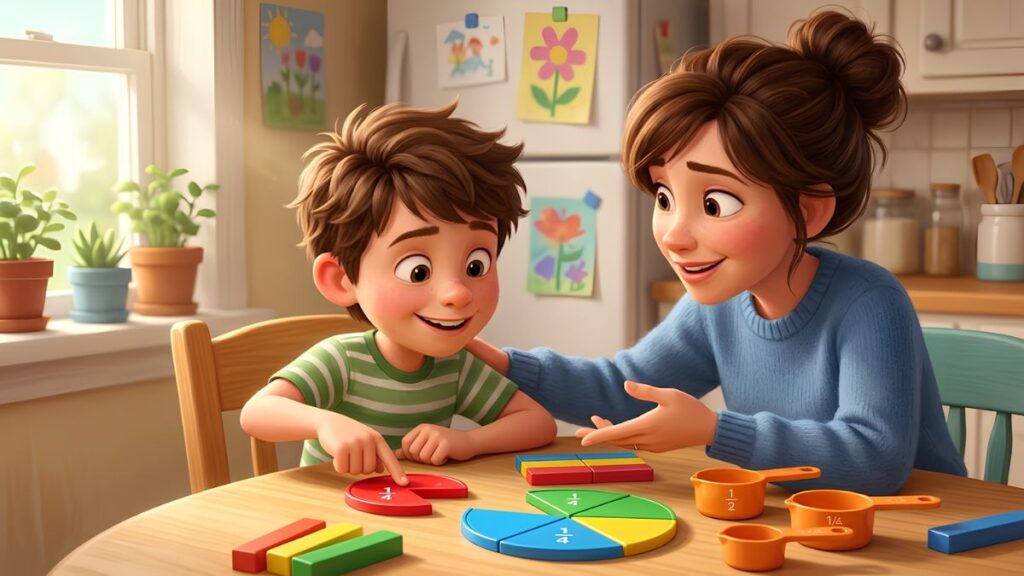
Fractions are an important part of third-grade math, but they can initially feel very different from the whole numbers children have been using since early elementary school.
A student who can confidently add and subtract whole numbers may still wonder why 1/4 is smaller than 1/2, what the two numbers in 3/4 mean, or why different fractions can represent the same amount.
Finding the Best Ways to Explain Fractions to A 3rd Grader starts with making fractions visual, concrete, practical, and interactive. Instead of asking children to memorize rules, help them understand what fractions represent by using objects, drawings, fraction bars, number lines, games, and everyday examples.
A useful progression for finding the Best Ways to Explain Fractions to A 3rd Grader is:
Whole → Equal Parts → Visual Model → Fraction Words → Fraction Symbols → Number Line → Comparison and Equivalence
This progression gives children a strong foundation before they move into more complicated fraction concepts. By connecting fraction symbols to things they can see, touch, and describe, teachers can make abstract ideas easier to understand and help students develop greater confidence with fractions.
Why Fractions Can Be Challenging for 3rd Graders
Fractions require children to think about numbers in a different way.
When a child sees: 6
they usually think about six individual objects.
But when they see: 3/4
they need to understand several relationships:
- There is a whole.
- The whole has been divided into equal parts.
- There are four equal parts.
- Three of those parts are being considered.
- Each individual part represents 1/4.
- Three parts together represent 3/4.
Children may also develop misconceptions about the numbers themselves.
For example, a student might think: 1/8 > 1/4
because 8 is larger than 4.
Another child might think: 3/5 > 4/5
because 3 is smaller than 4.
These misunderstandings are normal. They can be addressed by repeatedly connecting fraction symbols to visual representations.
Best Ways to Explain Fractions to A 3rd Grader
Fractions can feel tricky for third graders until they can see how parts fit together to make a whole. Explore the Best Ways to Explain Fractions to a 3rd Grader using simple examples, visual models, hands-on activities, and everyday situations.
Start With the Concept of a Whole
Before introducing fraction notation, make sure the child understands what a whole is.
Use a paper circle, rectangle, apple, or another familiar object.
Say: “This is one whole.”
Then divide it into two equal pieces.
Explain: “We divided one whole into two equal parts.”
Each part is: 1/2
Put the pieces together again and ask: “What happens when we put both halves together?”
The child should see: 1/2 + 1/2 = 1 whole
This establishes the connection between parts and the whole.
Make Equal Parts a Major Focus
Children need to understand that simple fractional parts of a whole are equal in size.
Draw a rectangle divided into four equal sections.
Each section represents: 1/4
Then draw another rectangle divided into four sections of different sizes.
Ask: “Do these represent four equal fourths?”
Explain why they do not.
This activity is important because children can otherwise develop the idea that simply dividing something into four pieces automatically creates fourths.
Use Food to Introduce Fractions
Food provides natural examples because sharing is easy to visualize.
Imagine one pizza divided into four equal slices.
Each slice represents: 1/4
If a child takes two slices: 2/4
If they take three: 3/4
If all four are taken: 4/4 = 1 whole
Ask questions such as:
- How many pieces are there?
- How many pieces were eaten?
- What fraction was eaten?
- What fraction remains?
This turns fraction learning into a meaningful activity.
Introduce Numerator and Denominator After the Concept
Do not begin by asking children to memorize:
“The numerator is on top and the denominator is on the bottom.”
First show the concept.
For: 3/4
explain:
Denominator: 4
The whole is divided into 4 equal parts.
Numerator: 3
We are considering 3 of those parts.
Then show a picture with four equal sections and three shaded.
The child can connect: Picture → Meaning → Fraction
This is more useful than memorizing vocabulary alone.
Use a Simple Memory Phrase
A child-friendly explanation can be:
“The bottom number tells how many equal pieces make the whole. The top number tells how many pieces we have.”
Repeat this language during different activities.
However, always connect the phrase to a visual model so that the child understands the idea behind it.
Use Fraction Circles
Fraction circles are particularly effective for teaching:
- Halves
- Thirds
- Fourths
- Eighths
- Equivalent fractions
- Fraction comparisons
Start with a complete circle.
Then show the same-sized circle divided into:
- 2 pieces
- 4 pieces
- 8 pieces
Ask: “Which piece is largest?”
The child should be able to see that: 1/2 > 1/4 > 1/8
This is much more intuitive than simply giving the child a comparison rule.
Use Fraction Bars for Comparisons
Fraction bars allow children to compare different fractions using the same-sized whole.
For example:
- 1 whole
- 1/2
- 1/4
- 1/8
Line them up so that the child can see their lengths.
Ask: “Which fraction covers the most space?”
Then introduce: 1/2 > 1/4 > 1/8
The visual model explains why.
Teach Fractions on a Number Line
A number line is essential because it helps children understand that fractions are numbers, not just pieces of objects.
Start with: 0 —————- 1
Divide it into two equal sections: 0 ——– 1/2 ——– 1
Then into four: 0 — 1/4 — 1/2 — 3/4 — 1
Ask the child to identify each location.
Then ask: “Which is closer to 1: 1/2 or 3/4?”
This encourages mathematical reasoning.
Connect Fractions to Whole Numbers
Help children see that whole numbers and fractions belong to the same number system.
For example: 0 < 1/4 < 1/2 < 3/4 < 1
Later, you can introduce: 1 < 5/4 < 2
using fraction models.
This prevents the misconception that fractions are somehow completely separate from whole numbers.
Teach Fractions of a Group
Use collections of objects.
For example, place 12 stars on a page.
⭐ ⭐ ⭐ ⭐
⭐ ⭐ ⭐ ⭐
⭐ ⭐ ⭐ ⭐
Shade or circle 3.
Ask: “What fraction of the stars did we select?”
There are 12 objects and 3 selected: 3/12
You can then discuss how the selected group relates to the whole group.
This helps children understand that fractions can describe parts of a set, not only parts of a single shape.
Use Classroom Objects
You do not always need special math manipulatives.
Use:
- Pencils
- Crayons
- Books
- Blocks
- Counters
- Chairs
- Toys
For example: “There are 10 pencils. 5 are blue. What fraction of the pencils are blue?”
This gives children an opportunity to see fractions in their classroom environment.
Demonstrate Equivalent Fractions Visually
Equivalent fractions are much easier when children can see that the amount remains unchanged.
Start with: 1/2
Show a rectangle divided into two equal sections and shade one.
Then divide the same whole into four equal sections and shade two: 2/4
Then divide it into eight equal sections and shade four: 4/8
The child can see: 1/2 = 2/4 = 4/8
Explain that the number of pieces changes, but the amount represented remains the same.
Use Folding to Reinforce Equivalent Fractions
Give each child a strip of paper.
Fold it in half.
Mark: 1/2
Then fold or divide it into four equal sections.
Show how the same half now contains: 2/4
Continue with eighths if appropriate.
This hands-on experience can make equivalent fractions much easier to remember.
Teach Comparing Fractions in Stages
Begin with fractions that have the same denominator.
Example: 2/6 and 5/6
Because both are divided into sixths, the child can compare the number of selected pieces.
Therefore: 5/6 > 2/6
Once this is understood, move to simple fractions with different denominators.
For example: 1/2 and 1/4
Use a visual model to demonstrate that: 1/2 > 1/4
Explain Why More Parts Can Mean Smaller Pieces
This is a key concept.
Use two identical rectangles.
Divide the first into: 2 equal parts
Divide the second into: 8 equal parts
Ask: “Which individual piece is bigger?”
The child can see that one-half is larger than one-eighth.
Explain: “When the same whole is divided into more equal pieces, each piece becomes smaller.”
This helps prevent the common mistake of thinking that a larger denominator always makes a fraction larger.
Introduce Benchmark Fractions
Teach children to use familiar fractions as reference points.
Useful benchmarks include:
- 0
- 1/2
- 1
For example: Is 3/8 less than or greater than 1/2?
A fraction number line can help the child determine that: 3/8 < 1/2
Benchmarking helps students develop a sense of the approximate size of a fraction.
Use Measurement Activities
Fractions appear naturally in measurement.
Use:
- Rulers
- Measuring cups
- Measuring spoons
- Tape measures
- Clocks
For example: “Find 1/2 on the ruler.”
Or: “Fill a cup to the 1/4 mark.”
Children can physically observe fractional measurements rather than only seeing them in textbooks.
Connect Fractions With Time
A clock is an excellent fraction model.
A complete clock represents: 1 whole hour
Half an hour: 1/2 hour = 30 minutes
A quarter of an hour: 1/4 hour = 15 minutes
Three-quarters of an hour: 3/4 hour = 45 minutes
This gives children a practical reason to understand fractional quantities.
Use Fraction Word Problems
Once the child understands visual fractions, introduce simple word problems.
For example:
“A chocolate bar has 8 equal pieces. Noah eats 3 pieces. What fraction of the chocolate bar did he eat?”
The child can:
- Draw the chocolate bar.
- Divide it into 8 equal sections.
- Shade 3.
- Write 3/8.
- Explain the answer.
This encourages the child to connect reading, visualization, and mathematical notation.
Encourage Multiple Representations
Ask children to represent the same fraction in different ways.
For example:
Show 3/4 using:
- A fraction circle
- A rectangle
- A number line
- A group of objects
- A fraction bar
The child begins to understand that the fraction is the quantity, while the models are different ways of representing that quantity.
Use a Fraction Anchor Chart
Create a classroom chart containing:
- Whole: One complete shape.
- Numerator: Number of selected parts.
- Denominator: Number of equal parts.
- Equivalent Fractions: Different fraction names for the same amount.
- Number Line: Shows where fractions are located.
Keep the chart available during independent work.
Use Fraction Games
Games provide repeated practice while keeping the lesson engaging.
Fraction Matching
Match fraction symbols to visual models.
Fraction Bingo
Students identify the fraction represented by a picture.
Fraction War
Players compare fraction cards.
Fraction Sort
Sort fractions into:
- Less than 1/2
- Equal to 1/2
- Greater than 1/2
Build the Whole
Students combine fraction pieces to make one whole.
23. Let Children Make Their Own Fraction Problems
After practicing several examples, ask the child to create one.
For example: “Draw a fraction and write a question about it.”
The student might draw six equal sections with four shaded and ask: “What fraction is shaded?”
This is a useful way to check deeper understanding.
Use Fraction Journaling
A simple fraction journal can include prompts such as:
- Today I learned…
- One-half means…
- I know 2/4 equals 1/2 because…
- Draw a picture of 3/5.
- Which is larger: 1/2 or 3/8? Explain why.
This combines mathematical thinking with writing and drawing.
Gradually Reduce Visual Support
Visual aids are extremely useful, but the goal is eventually for students to reason independently.
A good progression is:
- Beginning: Use physical fraction pieces.
- Developing: Use drawings and fraction bars.
- Practicing: Use number lines and symbols.
- Independent: Solve simple problems using mental reasoning and mathematical notation.
Do not remove the visual support too quickly. If a child still needs a model, continue using it.
Teach Fractions Through Multiple Senses
Children can benefit from seeing, touching, saying, and writing fractions.
For example:
- See: Look at 3/4.
- Touch: Build 3/4 using fraction pieces.
- Say: “Three-fourths.”
- Write: 3/4.
- Draw: Shade three of four equal sections.
This repeated connection can strengthen understanding.
Focus on Understanding Before Speed
A child should not be expected to identify fractions quickly before understanding them.
Give the student time to:
- Draw
- Count
- Compare
- Explain
- Ask questions
- Correct mistakes
Speed can develop naturally after the concepts become familiar.
Keep Practice Short but Consistent
Instead of assigning a very large worksheet, use shorter activities several times a week.
For example:
- Monday: 10 minutes of fraction models
- Tuesday: 10 minutes of number lines
- Wednesday: 10 minutes of comparison
- Thursday: 10 minutes of equivalent fractions
- Friday: Fraction game and review
Frequent exposure is often more useful than occasional long practice sessions.
Watch for Common Misconceptions
“The Bigger Bottom Number Means a Bigger Fraction.”
Use identical fraction bars to show why this is incorrect.
“3/4 Means 3 Divided by 4 Only.”
Explain that for a third grader, the fraction can be understood as three of four equal parts of a whole.
“All Four Pieces Have to Look Identical.”
Explain that they need to be equal in size, even if their orientation or shape is represented differently.
“Fractions Are Always Smaller Than 1.”
Eventually introduce fractions greater than one using concrete models.
Ask Questions That Encourage Reasoning
Instead of asking only: “What is the answer?”
ask:
- What does this fraction represent?
- How do you know?
- Can you draw it?
- Can you show it another way?
- Where would it go on a number line?
- Which fraction is larger?
- What makes you think that?
- Can you find an equivalent fraction?
- What happens if we divide the whole into more parts?
These questions encourage children to think mathematically rather than simply guess.
Example: Teaching 3/4 From Beginning to End
Suppose you want to teach: 3/4
Step 1: Show a Whole
Draw one rectangle.
Step 2: Divide It
Divide it into four equal parts.
Step 3: Shade Three Parts
The student sees three shaded sections.
Step 4: Name It
Say: “Three-fourths.”
Step 5: Explain the Denominator
“The 4 tells us there are four equal parts.”
Step 6: Explain the Numerator
“The 3 tells us that three parts are shaded.”
Step 7: Place It on a Number Line
Show: 0 — 1/4 — 1/2 — 3/4 — 1
Step 8: Compare
Ask: “Is 3/4 greater than 1/2?”
Step 9: Connect to Real Life
Ask: “If a sandwich is cut into four equal pieces and you eat three, what fraction did you eat?”
This single lesson connects the fraction to a model, vocabulary, symbol, number line, comparison, and real-life situation.
A Simple Weekly Fraction Plan
| Day | Main Activity | Skill |
|---|---|---|
| Monday | Fraction circles | Parts of a whole |
| Tuesday | Fraction bars | Comparing fractions |
| Wednesday | Number lines | Fractions as numbers |
| Thursday | Paper folding | Equivalent fractions |
| Friday | Games and word problems | Application and review |
This type of routine gives children repeated opportunities to encounter the same concept in different ways.
How to Know if a 3rd Grader Understands Fractions
A child is developing a strong foundation when they can:
- Identify a whole.
- Divide a whole into equal parts.
- Identify simple fractions from pictures.
- Explain the numerator.
- Explain the denominator.
- Represent fractions using drawings.
- Place simple fractions on a number line.
- Compare familiar fractions.
- Identify simple equivalent fractions.
- Recognize fractions of a group.
- Explain their reasoning.
- Connect fractions to real-life situations.
The most important test is not whether the child can complete a worksheet quickly. It is whether they can explain what the fraction means and represent it in more than one way.
Final Thoughts
The best ways to explain fractions to a 3rd grader involve making fractions something children can see, touch, draw, describe, and use. Start with the idea of a whole and equal parts, then gradually introduce fraction notation, numerators, denominators, fraction bars, number lines, comparisons, and equivalent fractions.
Use familiar examples such as pizza, sandwiches, classroom objects, measuring cups, rulers, and clocks to show that fractions are part of everyday life. Encourage children to explain their reasoning rather than simply provide an answer.
Most importantly, move gradually from concrete objects to visual representations and finally to abstract symbols. When children understand that 3/4 is not just two numbers written one above the other but a specific quantity made up of three of four equal parts, they have developed the foundation they need for more advanced fraction concepts.
